It was a night to remember with the following businesses all recognised for their excellence and innovation either as a category winner or judges' commendation. Read their stories and view their videos below.
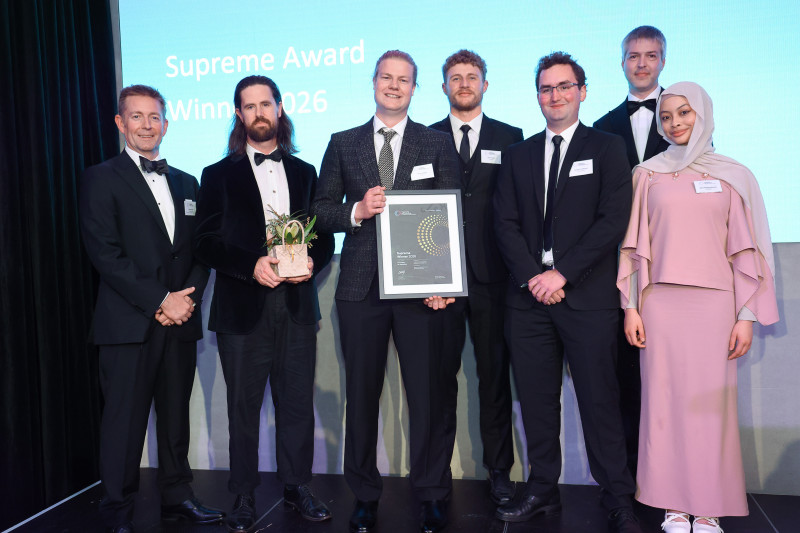
Supreme winner
Downer, Northpower, Omexom, Transpower and Ventia: Invisible risk to managed risk - redefining asset management
Substation structures and buswork is one of the most complex and difficult-to-manage asset classes on New Zealand's transmission network. Comprising of tens of thousands of interconnected components with diverse failure modes, these assets are difficult to access; requiring climbing, temporary access systems, or major outages for inspection. Historically, fragmented information, inconsistent condition data, and limited visibility of risk meant the portfolio could not be managed systematically at a national scale. This was a known problem for over 10 years and previous attempts made to solve it, weren’t successful.
To address this challenge, Transpower developed and embedded the first integrated asset management system for structures and buswork. Through a whole-of-system review and close collaboration with service providers, grid delivery, and asset managers, we created an end-to-end framework linking inspection, condition assessment, defect identification, project development, and investment decision making. The introduction of drone-based inspection technology enabled safe, repeatable assessment of previously inaccessible assets.
After two years in operation, the new asset management system has created approximately 24,000 managed assets, 65,000 condition measurements, and 1,500 defect work orders. It has prevented failures and loss of supply; uncovered previously hidden safety and reliability risks; enabled data-based planning for 31 substations; supported $43 million in newly planned projects; cancelled $11 million of unnecessary expenditure and deferred $22 million of expenditure.
The judges said this was an exemplar nomination. No other project delivered a bigger impact to the bottom line. It’s where everyone who manages infrastructure wants to be – managing things before something goes wrong.
Engineering for value
Winner - AECOM, Aurecon, Do Consulting, Niko Engineering, Value at Speed, XIS Graphic Design and Transpower: Power transformer in-bund oil containment design
This initiative unlocked a significant value engineering opportunity for in-bund oil containment across Transpower’s substation programme by challenging long-standing tertiary containment approaches. Traditional designs—relying on large tanks, extensive civil works, and complex pipe networks—met compliance requirements but introduced high cost, construction complexity, carbon footprint, and programme risk.
The need emerged from increasing delivery pressure, rising transformer costs within RCP4 & RCP5, and the opportunity to rethink solutions using a whole-of-life lens. Tactical Engineering led a collaborative effort with Asset Planning, delivery teams, and industry partners including AECOM, Niko, and Value at Speed to redefine the problem and explore credible alternatives.
A structured value engineering process was developed to systematically assess options through technical analysis, constructability reviews, environmental and safety risk assessments, and alignment with operational requirements and governance hold points. The resulting in-bund containment solution maintained the desired performance and compliance while significantly reducing complexity and construction impact.
Importantly, the solution has already been successfully designed and constructed across multiple sites, with Invercargill GXP as the first application, demonstrating practical implementation and stakeholder confidence.
This approach is expected to deliver savings of at least $0.5M per transformer site, with over 50 replacement and new sites anticipated over the next 10 years—equating to $25M+ in programme savings, alongside reductions in construction energy use and carbon emissions.
Beyond the technical outcome, the initiative has strengthened cross-functional collaboration and improved decision-making transparency. It demonstrates how disciplined engineering and clear governance can shift engineering practice—delivering better whole-of-life value while enabling more sustainable and efficient infrastructure investment.
The judges said this was a strong project that challenged the status quo and sought design improvements that would reduce costs while maintaining acceptable performance. It sounds simple but it is very smart.
Innovating for outcomes
Winner - Downer, Northpower, Omexom, Transpower and Ventia: Invisible risk to managed risk - redefining asset management
See supreme winner
Commendation - Transpower: Safer, scalable digital switching execution in Transpower control rooms
Switch execution is the step-by-step operation of high-voltage equipment to safely take assets in and out of service for maintenance or fault response. It is one of the most safety-critical activities in grid operations, where a single error can endanger lives or disrupt electricity supply.
Digital Switch Management Switch Execution transformed this process by replacing paper-based, manually coordinated switching with system-driven, real-time digital execution. The solution embeds structured workflows directly into DSM, enforcing sequential steps, validating live device state, surfacing cautionary and prohibitive tags, showing control ownership, and enabling single-click control invocation to reduce wrong-device operations. It also supports transfer of switching sequences between control rooms if one site becomes unavailable.
Live since December 2025, DSM Switch Execution addresses a material operational risk in control room operations, where around 160 grid outages are managed each week. Since go-live, switching-related control room incidents have reduced to zero.
It represents the most significant control room transformation since SCADA was introduced in the early 1980s, establishing a platform for field mobility, analytics, and future automation.
The judges wanted to recognise this project as it has reduced Human Error Incidents from eight a year to zero. This is a demonstration of core, fundamental innovation that will have significant positive impacts.
Investing in our industry’s future
Winner - ElectroNet Consulting: Graduate programme
Over 26 years ago, the EEA identified that the demand for qualified and experienced power engineers was going to increase. In 2002 the New Zealand power industry, together with the University of Canterbury, established the EPECentre at the University of Canterbury to focus on developing power engineers. In 2026 the EEA released the "Re-Energise 26" report, that highlighted that supply of new workers and engineering graduates is failing to keep pace with the workforce demands.
ElectroNet Consulting’s two-year Graduate Programme demonstrates a strong commitment to developing New Zealand’s future electrical engineers. Building on a proud 30-year history of supporting graduates and interns, the programme was formalised in 2020 to provide a structured and comprehensive development pathway. Graduates gain practical exposure to the design, maintenance, and expansion of electricity networks through six-month rotations across diverse technical and operational teams.
The programme’s flexible, tailored approach enables graduates to align rotations with their interests, strengths, and career goals while building valuable internal networks. This model ensures meaningful on-the-job learning, strengthens technical capability, and fosters engagement and retention. Ultimately, the programme delivers lasting value to both graduates and the organisation, supporting a sustainable and capable engineering workforce.
At ElectroNet consulting we have “grow our own talent” approach which resulted in our graduate program being the largest contributor of new appointments within the business ensuring New Zealand has a “brighter” future.
The judges said this was a strong programme based on solid principles of development and skill investment. It is well designed and uses modern teaching methods and comprehensively covers the industry. Proven results and impact over the last 6 years in developing future talent.
Commendation - Northpower: Building future inspection capability for New Zealand's transmission network
Inspecting New Zealand’s high-voltage transmission network has traditionally relied on ground-based visual and helicopter inspections, with limitations in data resolution, consistency, and condition visibility required for advanced asset management.
Over more than a decade, Northpower, in partnership with Transpower, has developed two specialist inspection capabilities. The first is acoustic partial discharge inspection, utilising new-generation acoustic technology from South Korea deployed in outdoor switchyards. This enables early detection of emerging electrical defects not visible through conventional methods, strengthening condition-based understanding of asset health. This required development of methodologies and the establishment of a specialist workforce, including acoustic inspection engineers.
The second is drone-based inspection of transmission conductor assets, supported by a dedicated workforce of drone pilots, data processors, and inspection engineers. A recent programme covered 667 km of conductor assets, capturing over 148,000 images at approximately 60% of forecast cost.
We successfully trialled the use of AI technology for post processing and put forward an innovation opportunity to Transpower for consideration. This is still being worked through.
Together, these capabilities deliver a scalable, condition-based inspection model that enhances data quality, improves asset visibility, and supports Transpower in delivering safer, more reliable electricity supply for New Zealanders.
The judges commended this project as large and interesting, embracing the use of novel and innovative technologies with demonstrated savings.
Category: Partnering for success
Winner - Hayes Metals, Macaulay Metals, Phoenix Recycling and Transpower: From grid assets to new value. A national recycling partnership
What links a statue of Colin Meads in Te Kuiti to the electricity transmission network? The copper content of its bronze is from recycled transformer windings!
With scrap metal quantities forecast to increase threefold from 300 tonnes per annum today to 900 tonnes per annum in RCP5, Transpower, its service providers and specialist metal recyclers have partnered in readiness. In 2026, with commitment from our service providers, Transpower established a national metal recycling panel with Hayes Metals, Macaulay Metals and Phoenix Recycling. It replaced a fragmented approach involving more than 30 separate recyclers.
The partnership delivers modern, data-rich financial and sustainability reporting, lifting probity and transparency to contemporary standards. We have improved assurance in safety, quality and environmental performance, through prequalification, streamlined engagement and expanded recycling pathways.
Our recyclers contribute advanced technology, bespoke engineering solutions and decades of network experience. With our service providers overseeing work in the field, our partnerships providing efficient resource recovery across activities ranging from tower deconstruction and transformer separation to complex cable processing. We’ve lifted sustainability, expanding recycling beyond metals to include batteries, concrete, glass insulators and relays.
Together we can achieve what we cannot alone. We’ve positioned ourselves to efficiently manage and recover $19m worth of materials through to 2035.
The judges said this was an initiative that demonstrates national impact, taking a fragmented system then creating a national platform. A great project that clearly sets out what it intended to achieve, how it got there and the future commercial benefits.
Category: Solving complex challenges
Winner - Transpower: Building a resilience capability to mitigate solar flares impacts
Transpower has developed an innovative monitoring and predictive analytics capability to strengthen the resilience of New Zealand’s electricity grid against solar flare events. Solar storms can trigger geomagnetic disturbances that induce harmful currents in long conductive assets such as transmission lines and connected power transformers, creating a low frequency but high-consequence system risk.
To address this, Transpower installed neutral current monitoring on originally 16 growing to 81 transformers across the network (now 113), creating a real-time monitoring system for geomagnetically induced currents. This gives control room operators immediate visibility of emerging risks and supports post-event analysis for Transpower, external partners, and the wider electricity industry. Building on this foundation, a Machine Learning model was developed to forecast the severity of impending solar storms for multiple regions across New Zealand.
The model integrates Transpower operational data with external inputs from GNS magnetometers, NOAA satellites, and other international space weather sources. Running every five minutes, it provides short-term forecasts that support critical operational decisions, including rerouting power flows, temporarily switching circuits out of service, and restoring supply at the optimal time. This initiative can shift Transpower from reactive response to proactive risk mitigation, improving asset safety, reducing the likelihood of customer disruption, and enabling coordinated industry-wide action.
The judges said this is a great example of complex engineering problem solving and an integrated solution to managing a complex and challenging problem.
Commendation - APD Global, Calibre, Heron Construction and Transpower: Marine tower foundations - neither land nor sea
The HEN–OTA-A 220 kV line is critical to security of supply for North Auckland and Northland. Five of its towers stand in the Whau Estuary on marine foundations built in 1965. After almost six decades in a harsh marine environment, the foundations are at end of life, with cracking through the pile caps.
Bringing a specialist marine contractor in during design, the team developed engineering and construction approaches together, treating access, logistical and environmental limits as core design inputs. Taking a staged construction sequence to install new piles around each existing foundation, joining the piles with a reinforced concrete ring beam, erecting a temporary steel frame and support for the tower, allowed the demolition of the existing foundation and building of the concrete structural raft and upstand inside the ring beam completing the foundation all the while ensuring the tower remained fully supported, and operational while providing power security.
At this time, we have built four of the five towers and the fifth is underway. To date there have been zero: unplanned outages, significant injuries, or concrete releases, across 64 new piles, ±988 m³ of concrete and 165+ barge movements. The selected approach assured a repeatable methodology for rebuilding foundations in a highly sensitive environment for this critical infrastructure.
The judges the commended the team for a great project highlighting a complex challenge and smart solution, very complex yet very well explained.