To connect assets to the power system, asset owners are required to provide real‑time operational data to Transpower in accordance with the Electricity Industry Participation Code.
Establishing and maintaining this data exchange is a mandatory part of connecting new assets, modifying existing assets, and operating assets that have a material impact on system operation or security.
Real‑time operational data enables the System Operator to maintain system visibility, assess operating conditions, and manage the power system safely and securely.
The asset types required to provide real‑time operational data are outlined below.
- Generation assets – including battery energy storage systems (BESS)
- Load assets – including large industrial loads and electricity distribution businesses (EDBs)
- Network support assets – including STATCOMs, SVCs, synchronous condensers, and large capacitor or reactor installations
If you are familiar with our process and are ready to engage with us to initiate an operational data integration project for your asset, use this form.
Key components of operational data integration (ODI)
Operational data integration relies on a small number of core technology components that work together to enable secure, real‑time information exchange between asset owners and Transpower.
This overview is intended to provide a high‑level understanding of those components before moving on to the process steps that follow.
- Asset owner SCADA system
The asset owner maintains a supervisory control and data acquisition (SCADA) system that collects real‑time measurements, status indications, and alarm information from the asset.
This system is the source of operational data provided to Transpower
- Telecommunications and connectivity
A secure and resilient telecommunications path is required to enable continuous data exchange between the asset owner’s environment and Transpower.
This typically includes fibre managed telecommunications services, along with supporting network equipment, to meet availability, performance, and cyber security requirements
- Data exchange using industry‑standard protocols
Real‑time operational data is exchanged between the asset owner’s SCADA system and Transpower’s SCADA systems using the industry‑standard Inter‑Control Centre Communications Protocol (ICCP)
This supports consistent, secure, server‑to‑server transfer of operational information across the power system.
- Transpower SCADA and control room systems
Transpower receives and ingests operational data into its SCADA and control room systems, providing the System Operator with real‑time visibility of asset status and operating conditions for system monitoring and operation.
Image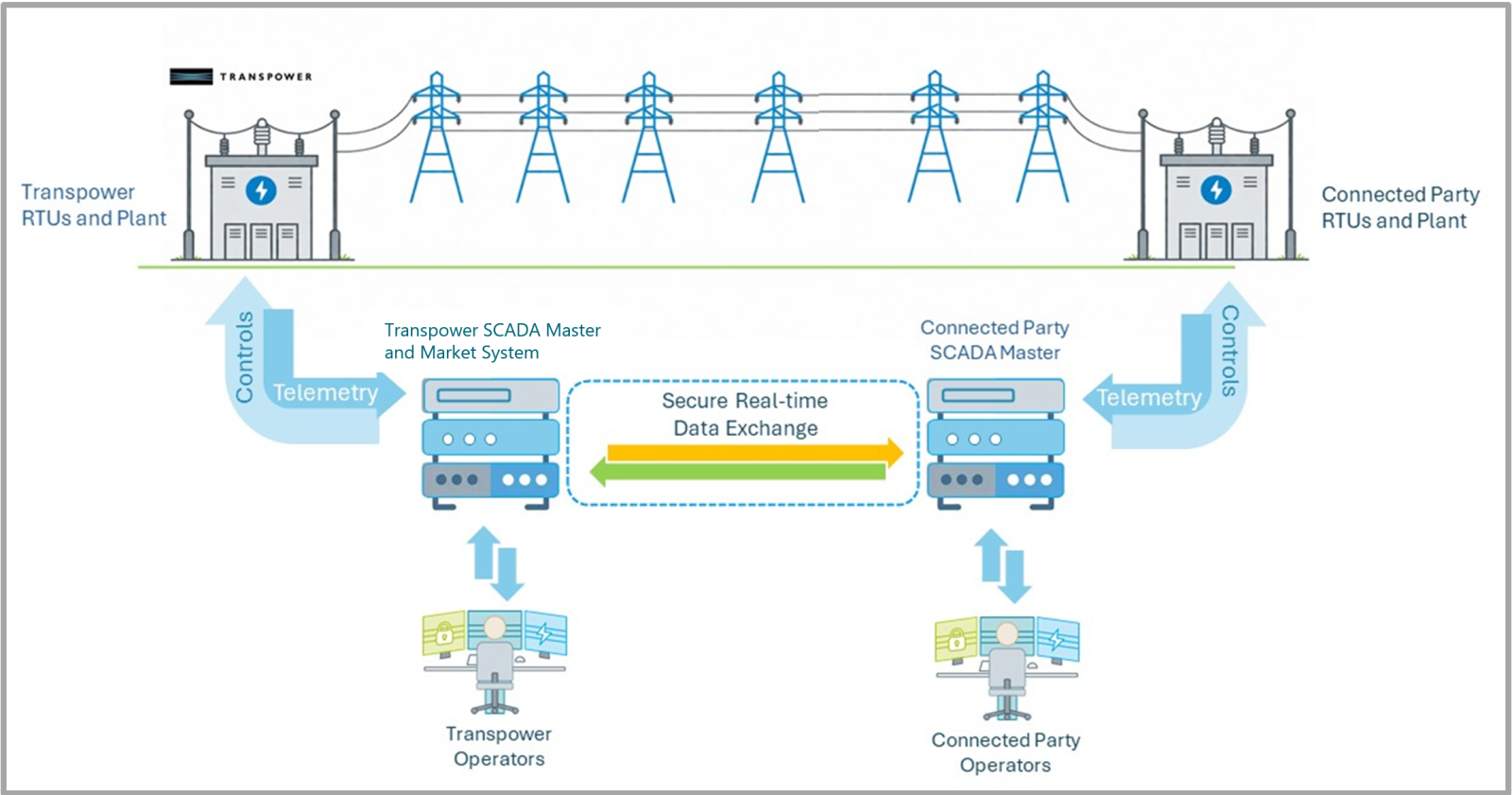
The diagram above illustrates the data exchange between connected assets & Transpower
- Dispatch via ICCP
Asset owners may choose to use their ODI connection to receive and respond to dispatch instructions using the Inter‑Control Centre Communications Protocol (ICCP).
Further information on dispatch arrangements and how to configure this capability is available on the Dispatch & Offers webpage.
Key stages of operational data integration (ODI)
When you are ready to establish or change an operational data integration (ODI) connection, asset owners must initiate the process by using this form.
This provides Transpower with the information needed to commence the process, after which Transpower will contact you to guide you through the steps outlined below for your ODI work request.
To learn more about the ODI workstream & process, read through the activities listed in Workstream B of the Generation Connection Guide. A dataset template for the above indications and measurements is available here.
- Telecommunications feasibility and delivery
Where a suitable communications connection is not already in place, a secure and resilient telecommunications solution will be identified and delivered to support connectivity between the asset owner’s environment and Transpower.
This typically includes fibre‑based telecommunications services and supporting network equipment. Telecommunications delivery is often a long‑lead activity and may take up to 12 months, so should be considered early. Assets with existing compliant communications may not need to complete this step.
- Dataset definition and update
The operational data to be exchanged is defined or updated, including the required measurements, indications, and status information.
This step applies both to new ODI connections and to changes to existing connections, with the asset owner configuring their SCADA system to add, remove, or amend data as required by Transpower.
- Connection validation and testing
Data exchange is validated to confirm that operational data is received correctly, securely, and reliably by Transpower’s systems. For changes to existing ODI connections, testing is typically scoped to the affected datasets or interfaces rather than re‑testing the full connection.
Ongoing operation
Once operational, ODI connections must be maintained over their lifecycle, with Transpower remaining the point of contact for support, changes, and ongoing coordination.
- Changes to assets, SCADA, datasets, or communications
Submit a new Operational Data Integration (ODI) work request to notify Transpower of any changes that may affect the operational data exchange
- Planned outages
If you schedule a planned application outage, you must inform Transpower at least three weeks before any such outage lasting longer than a few minutes. Do this by submitting a test plan form to [email protected]
- Unplanned outages or operational or real‑time issues
For application outages impacting realtime, contact
- [email protected] – for system support
- [email protected] – for dispatch issues (using ICCP)
- [email protected] – for control room support or guidance
We are committed to continuously improving how we support the power system, our customers, and our stakeholders. Have an idea to boost efficiency, improve communication, or solve a current challenge? We want to hear it! Please take a few moments to complete our brief feedback and improvement form