What is the Transmission Pricing Methodology?
The Transmission Pricing Methodology (TPM) is part of the Electricity Industry Participation Code 2010 (Code). The TPM determines how Transpower recovers its costs from parties who connect directly to the national electricity transmission grid (Transpower’s customers) through transmission charges. These include generators, battery owners, distributors (local lines companies), and some large consumers.
Key principles of the TPM:
The TPM is based around principles of cost reflectivity and benefit-based charging:
- Cost reflectivity means that transmission charges paid by each customer reflect the costs of providing transmission services to that customer. This supports efficient decision making around consumption and supply and, in aggregate, enables Transpower to recover its costs.
- Benefit-based charging is about allocating the costs of transmission investments to those expected to benefit from each investment. This applies to connection investments, new interconnection investments, and seven specified historical interconnection investments. Most of Transpower’s other costs are shared among load customers, including grid-connected battery owners, through residual charges under the TPM.
The TPM was developed to accommodate changes in technology and market conditions and to align with a transition to cleaner energy.
- Key pricing dates
Transpower’s annual pricing cycle works as follows:
- 30 June: At financial year end we 'close' the asset register – transmision charges for the following pricing year (1 April to 31 March) are based on this 'snapshot'; any changes after that date are processed as within year adjustments' (see later section).
- Mid to late September: We consult with our customers on the inputs to pricing that will apply from the start of the next pricing year (assets, demand and injection figures, adjustment events, and so on). This is so customers can be confident regarding the process and inputs used to calculate their transmission charges.
- December: We notify our customers of their transmission charges for the upcoming pricing year.
- 1 April: New pricing year begins with updated transmission charges taking effect.
Transmission charges
When you connect to the grid, you will be required to pay transmission charges. The TPM specifies how Transpower must calculate transmission charges.
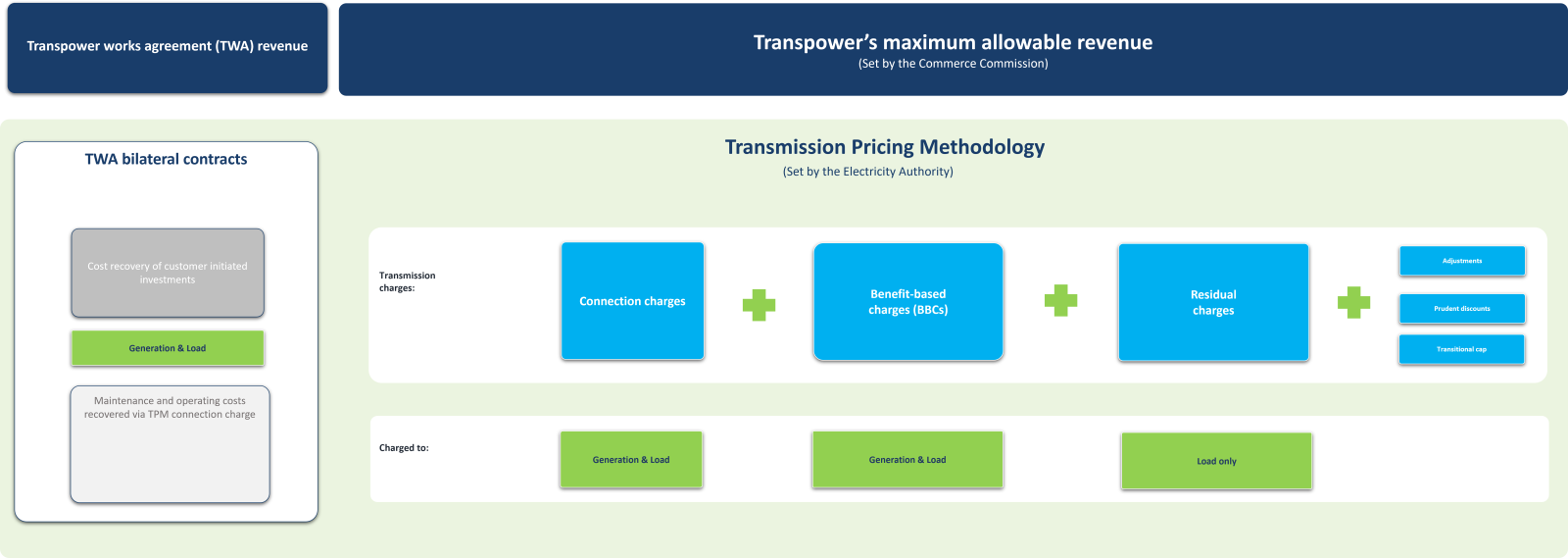
The diagram below illustrates the three main components that make up transmission charges under the TPM and the customers to whom those components apply:
What charges apply to generators and when?
When you connect generation plant directly to the grid, your transmission charges begin immediately.
The specific charges you will pay are:
- Connection charges – recover the costs of connecting customers to the grid via specific assets
- Benefit-based charges (BBCs) – recover the costs of benefit-based investments (BBIs) from customers who benefit from them.
- Other charges – various smaller components like prudent discount recovery charges. These are not discussed in this Guide, but more information is available on Transpower’s website.
As an injection customer, you won't pay residual charges, which are allocated among load customers only.
Your transmission charges will change between pricing years. Your charges can also change within a pricing year in response to specified events (called adjustment events), as discussed in the section on within year adjustments.
Connection Charges
Connection charges recover the cost of transmission assets that connect specific customers to the interconnected grid.
These are the assets that exist primarily to serve customers’ connections, though they may be shared with other parties (shared connection assets). Where new connection assets are required to connect a customer to the grid, these are usually funded under a Transpower Works Agreement (TWA) between the customer and Transpower. The capital cost of the connection assets will be recovered through the TWA, not the TPM, but there will still be maintenance and operating cost components for the connection assets allocated to the customer under the TPM. More information about TWAs is provided later in this Guide.
Connection charges are calculated on a ‘pool and share’ basis. The total value of the pool is based on our regulatory asset base (which is an input to the calculation of our allowable revenue under Part 4 of the Commerce Act 1986). Pooled connection asset costs are allocated to connection assets and the customers connected to them using deemed asset replacement costs, line length or switch numbers, rather than Transpower’s actual cost of building, maintaining and operating the specific assets. This approach smooths out connection charges over time, so that charges better reflect the service delivered to customers via the assets.
The connection charge for a connection asset is made up of:
- Asset component: Provides a return of and on our capital investment in connection assets. This component is zero if the assets are funded under a TWA
- Maintenance component: Recovers maintenance costs for connection assets
- Operating component: Recovers operating costs for connection assets.
There is also a funded asset component of connection charges to address first mover disadvantage, which is not discussed in this Guide. More information about the first mover disadvantage mechanisms in the TPM is available on our website at About the TPM.
The above components are calculated as follows:
- The asset component is calculated for each connection asset by multiplying the asset’s replacement cost by the asset return rate (ARR). The ARR is Transpower’s return of and on investment across all connection assets for the pricing year (calculated using Transpower’s regulated weighted average cost of capital (WACC)) divided by the total replacement cost of all connection assets at the end of the previous financial year.
- The maintenance component is calculated as follows:
- For a station asset, by multiplying the asset’s replacement cost by the maintenance return rate (MRR) for stations. The MRR for stations is the average annual maintenance costs for station assets over the previous four financial years divided by the total replacement cost for those assets at the end of the previous financial year. This reflects that larger or more complex assets cost more to maintain.
- For a line asset, by multiplying the line length by the MRR for the line type. Four different line types are used. For each one, the MRR is the average annual maintenance costs for the line type over the previous four financial years divided by the total line length of those assets at the end of the previous financial year.
- The operating component is calculated for each connection asset by multiplying the number of AC switches in the asset by the operating recovery rate (ORR). The ORR is based on total switch operating costs over the previous financial year and the total number of switches in the grid.
If a single customer is connected to the connection asset, that customer will pay the asset’s connection charge in full. However, if the connection asset is shared between more than one customer, the asset’s connection charge is allocated to each customer based on the customer’s anytime maximum demand and injection (AMDC) or anytime maximum injection (AMIC) at the connection location (AMDIC), as a proportion of all customers’ AMDIC at that location.
An information sheet providing more details on connection charges is available at About the TPM.
Benefit-Based Charges (BBCs)
BBCs recover the costs of benefit-based investments (BBIs) from customers who are expected to benefit from them. BBIs are interconnection investments commissioned after 23 July 2019, plus seven specified historical investments (Appendix A BBIs).
BBCs recover the costs of benefit-based investments or BBIs
)from customers who are expected to benefit from them. BBIs are interconnection investments commissioned after 23 July 2019, plus seven specified historical investments (Appendix A BBIs).The “covered cost” of each BBI comprises:
- capital costs (return on and of investment)
- opex (operating and maintenance costs) directly attributable to the BBI. I.e., the forecast costs of maintenance, inspections and operations for a specific asset(s)
- other opex reasonably attributable to the BBI (allocated share of Transpower's overhead opex)
- tax components.
The covered cost of a BBI is calculated annually and varies over time due to several factors, including asset lifecycle stage and regulated WACC. For more information, see TPM Information Sheet - BBC Covered Costs.
BBI allocations calculated under the TPM allocate a BBI’s covered costs to customers. There are three methods for calculating starting allocations for post-2019 BBIs under the TPM:
- Simple method (for investments ≤ $30 million)
- Standard method – price-quantity (for most investments > $30 million)
- Standard method – resiliency (for investments >$30 million addressing high-impact, low-probability (HILP) risks).
Simple Method BBCs
The simple method is used for smaller, post-2019 BBIs (≤$30 million) such as routine replacement of insulators and tower components. The simple method avoids complex benefits modelling of individual investments, instead using fixed allocations based on historical grid use. Simple method allocations are fixed for five-year periods, subject to specified adjustment events. The simple method allocates costs 67.5% to offtake customers (load) and 32.5% to injection customers (generators, including batteries)
For more information, see TPM Information Sheet - BBC Simple Method.
Standard Method
The standard method are used for larger post-2019 BBIs (>$30 million). These involve detailed economic modelling to determine which customers benefit from the relevant BBI and in what proportions.
We use one of two standard methods, depending on the BBI:
- Price-quantity method: Used for most large interconnection investments, analysing market price and quantity impacts
- Resiliency method: Used for large interconnection investments primarily addressing high-impact, low-probability (HILP) risks.
The price-quantity standard method uses complex modelling and power system analysis, while the resiliency standard method uses a much simpler approach, estimating resiliency benefits based on historic grid offtake in the region in which the HILP risk is mitigated.
Generators do not receive significant BBI allocations under the resiliency standard method.
For more information, see TPM Information Sheet - BBC Standard Methods.
Appendix A BBIs
The Electricity Authority selected seven specific historical interconnection investments (built before July 2019) to be BBIs because the Electricity Authority could identify the beneficiaries for them. The Electricity Authority set starting allocations for each such BBI and beneficiary in Appendix A of the TPM. The Appendix A BBIs are:
- Bunnythorpe-Haywards Reconductoring Project
- Pre-July 2019 investments in the HVDC link
- Lower South Island Renewables Project (first tranche, completed 2016)
- Lower South Island Reliability Project
- North Island Grid Upgrade (NIGU) Project
- Upper North Island Dynamic Reactive Support (UNIDRS) Project
- Wairakei Ring Project.
The costs of all other historic (pre-July 2019) interconnection investments are recovered through residual charges.
See TPM Information Sheets - BBC for Appendix A BBIs (link to appendix A info sheet) and TPM Information Sheet - BBC Adjustment Events.
Residual Charges
Residual charges recover any remaining revenue not recovered through other transmission charges, ensuring Transpower recovers its full allowable revenue each pricing year.
Residual charges recover any remaining revenue not covered through other transmission charges, ensuring Transpower recovers its full allowable revenue each pricing year. This includes the costs of pre-2019 interconnection investments that are not Appendix A BBIs. We expect that these charges will decrease over time as these older investments depreciate.
Residual charges are allocated in proportion to customers’ gross load, being total load “behind” the grid even if that load is not supplied through grid offtake. The gross load measurement used to allocate residual charges is lagged by up to eight years. New load does not count towards gross load for four years, then ramps up its contribution over the following four years.
Generators do not pay residual charges unless they take power from the grid when not generating.
For more information, see TPM Information Sheet – Residual Charges.
PRICING OVER THE GENERATOR LIFECYCLE
- Indicative pricing
Transpower can provide detailed indicative pricing to help you understand your likely transmission charges, for projects that have reached stage 4 of our grid connection process (Investigation stage). Responses are typically within 20 working days.
To get detailed indicative pricing from Transpower, you'll need to provide certain information about your proposed plant and its connection. If the information you provide about your project includes staged commissioning or variable output over time, we will advise the impact of these factors on indicative pricing.
Alternately, there are self-service tools available on our website, which will provide indicative pricing using Transpower's $/MWh tables, connection charge examples, and residual charge rates.
Visit Transpower's Indicative Pricing page for current estimates and tools.
Transpower Works Agreements (TWAs)
If your plant’s connection to the grid requires new or upgraded connection assets to enable the connection, you'll need to enter into a TWA with Transpower.
Under a TWA, Transpower agrees to build or upgrade connection assets, and the customer agrees to reimburse Transpower for the capital cost of the new or upgraded connection assets (including a return on investment) through charges under the TWA. TWAs are commercial agreements separate from the TPM, and TWA charges are not transmission charges.
- If the capital cost of a connection asset is reimbursed through TWA charges, the asset component of its connection charge under the TPM is zero. The customer will only pay the operating and maintenance components of connection charge for the asset under the TPM.
- When the asset reaches end of life and is replaced, the customer will transition to paying a standard TPM connection charge, including the asset component, unless a new TWA is agreed.
For more information about the connection process and TWA requirements, see Transpower's grid connection process.
- Within year adjustments
Your transmission charges can change after they are confirmed for a pricing year if an "adjustment event" occurs. There are different types of adjustments for different transmission charges. Note that while these adjustments may be triggered during a pricing year, charges are generally reconciled to reflect the adjustments in the following pricing year.
There is overlap between the adjustment events for different transmission charges. For example, if you connect plant to the grid at a new connection location, that is an adjustment event for your connection charges and BBCs. If you sell all or part of your business that constitutes you as a customer, that is an adjustment event for your connection charges and BBCs.
Adjustment events are particularly significant for BBCs because BBCs are not subject to annual adjustment based on grid use, as connection charges for shared connection assets and residual charges are. BBC adjustment events include:
- Connecting new plant to the grid or large plant (≥10MW) to a distribution network
- A large (≥10MW) upgrade or de-rating of grid-connected or embedded plant
- A substantial and sustained increase in consumption or generation by large plant (≥25% and expected to last at least 5 years)
- Disconnecting plant from the grid or large plant from a distribution network.
- Disconnecting from the grid
Because plant connection or disconnection can be an adjustment event for transmission charges, it is important that you discuss your connection or disconnection plans with us as early as possible to ensure the TPM requirements are met.
If you disconnect from the grid entirely, all your transmission charges will end immediately. However, any TWA charges will continue in accordance with the relevant TWA, and you may continue to pay transmission charges passed through by distributors if you still have plant connected to their distribution networks.
Contact Transpower
For questions about how the TPM applies to your specific connection, or to request indicative pricing, contact Transpower's customer team or visit the Transpower website for current contact information and resources (About the TPM).