Invitation to Tender 2026
The tender has now closed. Tender documents can be found below:
We have updated our approach to the tender this year. Instead of providing a tender response by email, we are using a digital form.
Before completing the online form, you will need:
- Tender Response Form A – Deviations
- Tender Response Form D – OFR
- Tender Response Form E – BS
- Company number and legal name of company
- Details of the primary contact at your organisation
An authorised person at your organisation will need to digitally sign the form. They should refer to the Tender Terms & Conditions and Invitation to Tender.
Click here to submit your tender response
Contract Templates
Find below the contract document templates, including ‘redline’ versions that can be used to see changes with the previous OFR and Black Start schedules:
Tender briefing
We held a tender briefing session for potential tenderers at 10:30 am on Thursday 22 October 2026 via Teams. The video of the session is available to watch below.
We covered the tender process, documentation, and discussed the changes in the service requirements and contract terms since we last tendered for OFR and South Island Black Start services in 2024.
System Operator Ancillary Services Tender Briefing 22 October 2026
|
If you have any questions about the tender, or have any issues filling out the form, you can reach out to the team via [email protected].
Q&A
Question: The email requirement for black start testing seems to significantly lower the bar compared with what is required in the current process. What is the requirement for the six weekly email?
Answer: The six weekly email for confirmation of a passed test only applies to black start auxiliary equipment that is tested on a six week cycle. This test is a simple confirmation that the diesel generator or auxiliary hydro plant starts without power from the grid or other network. There are no changes to the requirements for black start testing which involves a much more rigorous test of the black start service and is conducted every two years on average.
Question: Please clarify the addition of 'remote signalling' and when/where this will be utilised?
Answer: Remote signalling is specifically for over frequency reserves delivered through a control system rather than conventional relay equipment. A control system will not be armed/disarmed but will continue to operate when dispatched for over frequency reserve.
The System Operator will send a signal to the provider to indicate that the contracted over frequency reserve response is now required, and the provider's controls must then switch to the appropriate configuration.
Question: For over frequency reserve provided via tripping, is there a requirement to differentiate this from over frequency reserve provided via ramping in Appendix 1?
Answer: There is not currently a requirement to differentiate the method for providing over frequency reserve, however as the System Operator onboards different types of over frequency reserve response, this may be required.
Question: Please clarify what operational data will be accepted as verification of fully compliant operational performance following an over frequency reserve operation?
Answer: The System Operator will accept for verification of fully compliant operational performance, operational data with adequate resolution to validate that the site met the performance requirements as set out in the individual Ancillary Services Procurement Contract following an over frequency reserve event.
Question: Please confirm that during a black start test that the requirement for monitoring equipment measurement and data recording is for the first unit only and not subsequent units connected to the network busbar?
Answer: Monitoring equipment must measure and record data at each unit being tested for black start. The number of units tested must be agreed with the System Operator prior to testing.
Question: We request that any test of the remote synchronisation breaker during a black start test will be supported by an appropriate test methodology which will be provided by the System Operator for review no later than 10 business days prior to the scheduled test day. Test methodology should include a provision for a trial / dummy synchronisation immediately prior to the planned synchronisation breaker close.
Answer: The System Operator has considered this request and will provide a test methodology no later than 10 business days prior to the scheduled test date. The Ancillary Services Procurement Plan and contracts will be updated to reflect this change. A dummy synchronisation ahead of the actual synchronisation breaker close is standard practice and will be incorporated into the test methodology.
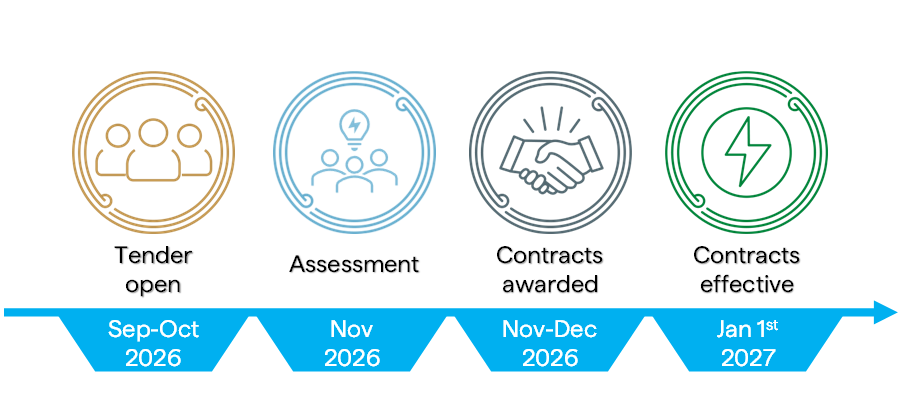
2026 Tender Timeline
The tender opened on Thursday 15 October 2026 and will close on Tuesday 3 November 2026.
Past Tenders
- 2025
The 2025 tender opened on 9 October and closed on 5 November. Below is the recording of the tender briefing held on 21 October.
We have published the questions received during the tender process, as well as our responses, here.