What are ancillary services?
Ancillary services are essential to maintaining the stability, reliability, and security of New Zealand’s power system. While the wholesale electricity market manages the supply and demand of energy, ancillary services ensure the power system continues to operate safely within its technical limits, particularly if there are sudden changes in generation, demand, or network conditions.
We procure ancillary services according to the Procurement Plan, which also sets the technical requirements and key contractual terms applicable to each service. We are required to use reasonable endeavours to both implement and comply with the Procurement Plan. You can find out more on our Procurement Process webpage, as well as by browsing our essential documents.
The Policy Statement sets out the policies used by the System Operator in scheduling and dispatching ancillary services to assist it in planning to comply and complying with its dispatch objective. The System Operator may at any time contract providers to meet this objective.
The System Operator procures four ancillary services depending on system needs. Click on each of them below to learn more:
- Black Start
Black start (BS) is the first step in the process of system restoration in the unlikely event of an island-wide blackout.
This service can only be carried out by a generating station that can self-start without requiring power from the wider system. We need to have this service available in both the North and South Islands so that the entire system could be re-energised following a blackout, and so that other generation can subsequently reconnect.
We procure black start on a firm quantity procurement basis (via a monthly availability fee and/or a single event fee for specified stations).
Service payments
Transpower as Grid Owner pays the allocated black start costs (see clause 8.56 in the Code for details). As an indication, for the 12 months to 31 May 2026, the costs for the procurement of black start services were approximately $843,000.
Image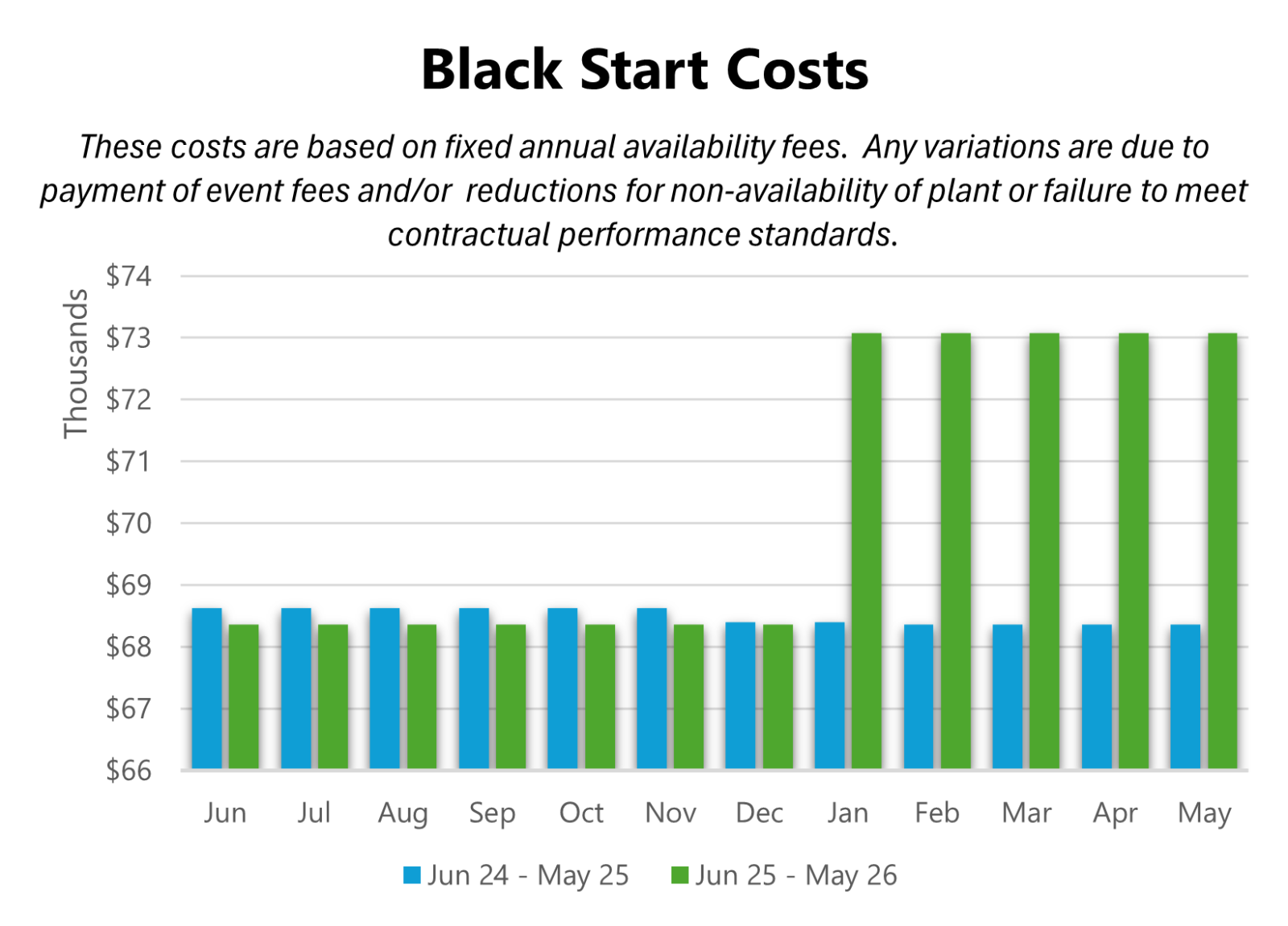
Net purchase quantity assessment
We currently procure two black start stations in each Island.
- Frequency Keeping
Frequency keeping services help to manage short-term supply and demand imbalances to ensure that the system frequency is maintained at or near 50 Hz. We procure two key types:
Multiple Frequency Keeping (MFK)
This service is provided by one or more generating units capable of quickly varying their output in response to instructions from the System Operator.
We procure MFK on a half-hour basis. Providers are paid their frequency keeping offer price for the dispatched MW band for each half hour they perform the service, as well as variable costs through constrained on-and-off payments designed to compensate them for any foregone energy market revenue.
A trial is being run from 1 September 2026 to 30 November 2026 looking at changing the current frequency keeping band. Details of the trial are available here.
Backup Single Frequency Keeping (BSFK)
This service is provided by one or more generating units who can independently monitor frequency and adjust their output without instructions from the System Operator. This service only takes effect if there are problems with the tools that deliver MFK.
We procure BSFK on a firm quantity procurement basis (via a monthly availability fee). If dispatched, providers are also paid the frequency keeping offer price for the dispatched MW band for the relevant trading period, in addition to constrained on and off payments.
Service payments
Frequency keeping costs are paid by purchasers of electricity on a national basis, proportional to their share of grid offtake quantities (see clause 8.58 in the Code for details). As an indication, for the 12 months to 31 May 2026, the costs for procuring frequency keeping were approximately $9.7 million.
Image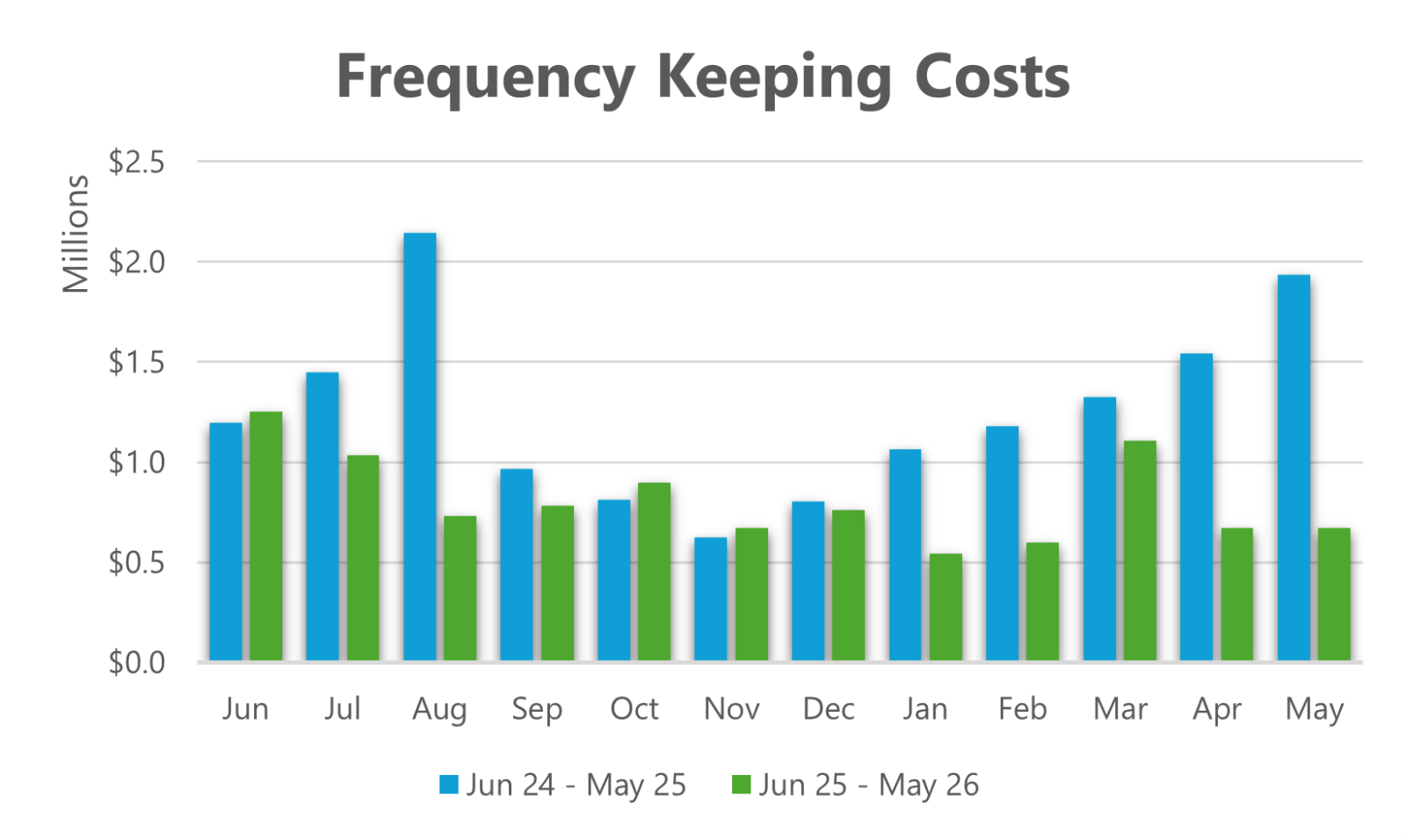
Net purchase quantity assessment
The range over which frequency keeping providers must be able to adjust their output is known as the frequency keeping band. We determine a frequency keeping band to be applied to each Island for each trading period; each Island has a 15 MW band. Where we propose to deviate from these quantities for a trading period(s), we advise market participants in advance via a Customer Advisory Notice (CAN).
Frequency keeping band
The minimum frequency keeping band is currently 8 MW (±4 MW).
- Instantaneous Reserve
Instantaneous reserve (IR) consists of generating capacity, interruptible load, or battery energy storage systems (BESS) that can operate automatically in the event of a sudden failure of a large generating plant or the HVDC link. This service is required to stop the resulting fall in frequency and allow the system frequency to recover promptly to 50 Hz.
There are two main products:
- Fast instantaneous reserve (FIR), which refers to the increase in generation or reduction in demand (in MW) provided no later than 6 seconds, and measured at 6 seconds, after the start of a contingent event (as defined in the Policy Statement). This must be sustained until at least 60 seconds after the start of that event.
- Sustained instantaneous reserve (SIR), which refers to the average increase in generation or reduction in demand (in MW) provided during the first 60 seconds after the start of a contingent event. This must be sustained for at least 15 seconds after the start of that contingent event, unless a new dispatch instruction is given before the expiration of that 15-minute period.
Each product can be supplied by different forms of instantaneous reserve: interruptible load and generation reserve. Generation reserve can be either of two offer types; partly loaded spinning reserve or tail water depressed reserve. Currently, the injectable BESS response is modelled as equivalent to tail water depressed reserve:
- Partly Loaded Spinning Reserve (PLSR) consists of spare capacity, held in reserve on a generating unit, generating, but not operating at full output, but excludes the spare capacity provided by an energy storage system (see Code definition for more).
- Tail Water Depressed Reserve (TWDR) consists of a generating capacity on a motoring hydro generation set with no water flowing through a turbine that is available following a drop in system frequency (see Code definition for more).
It is not expected that reserve would be offered from intermittent generation in isolation due to the variable nature of renewable energy sources. Hybrid intermittent generating stations, such as solar+BESS or wind+BESS, may consider offering reserve.
Under the current market arrangements, BESS may offer interruptible load to reduce the BESS demand when it is charging, and generation reserve to increase the BESS generation output after charging demand is reduced to zero. When the BESS is charging, both interruptible load and generation reserve may be offered in the same trading period.
Demand side participants can offer FIR or SIR through an interruptible load scheme.
We procure instantaneous reserve on a half-hour clearing market basis. Providers of IR are paid the marginal reserve price for their availability.
Service payments
From 1 October 2026, instantaneous reserve costs will be allocated to Transpower as the HVDC owner, and to asset owners of generating units - or groups of generating units comprising a single risk, with a maximum continuous output greater than 60 MW. The generating units and single risks subject to these costs are identified in this published list determined by the System Operator (see clause 8.59A of the Code, effective 1 October 2026). Information on how the System Operator categorises contingent events is available on the Event Categorisation page. We allocate costs on an island basis proportional to the quantity of electricity injected by a generator or the HVDC transfer quantity (see clause 8.59 in the Code for details).
As an indication, for the 12 months to 31 May 2026, the costs for procuring instantaneous reserve were approximately $7.0 million.
Image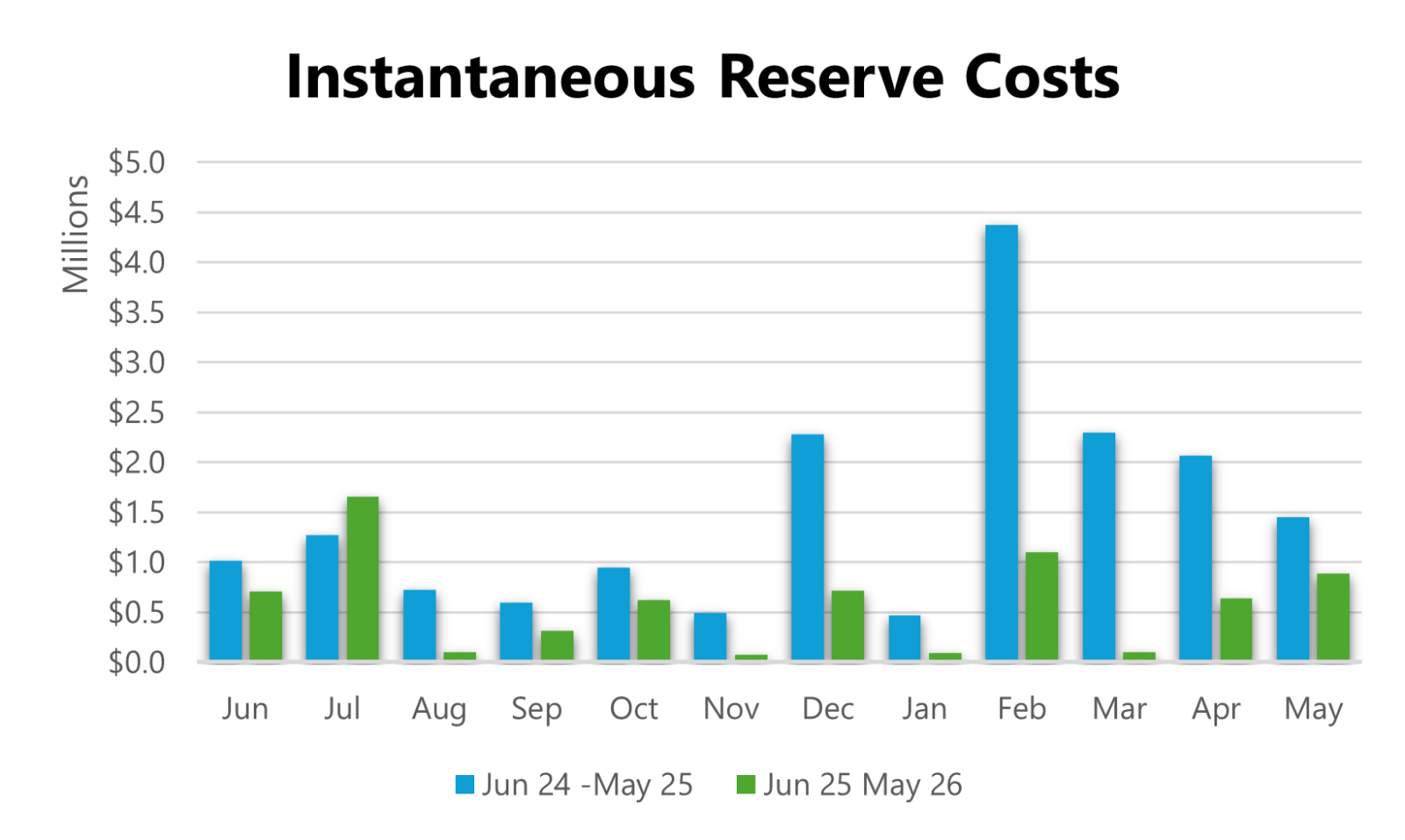
Net purchase quantity assessment
We use an application called the Reserve Management Tool (RMT) to calculate the amount of instantaneous reserve required for each trading period. To find out more about RMT see the Reserve Management Concepts Animation and the latest RMT specification document.
- Over-Frequency Reserve
Over-frequency reserve (OFR) is provided by generating units that can be armed when required and automatically disconnected from the power system due to a sudden rise in system frequency. This rise in frequency might be due to an unplanned loss of a large industrial load or the tripping of the HVDC link.
Service payments
Over-frequency reserve costs are paid by Transpower as the HVDC owner (see clause 8.57 in the Code for details). As an indication, for the 12 months to 31 May 2026, the costs for the procurement of over-frequency reserve were approximately $2.1 million.
Image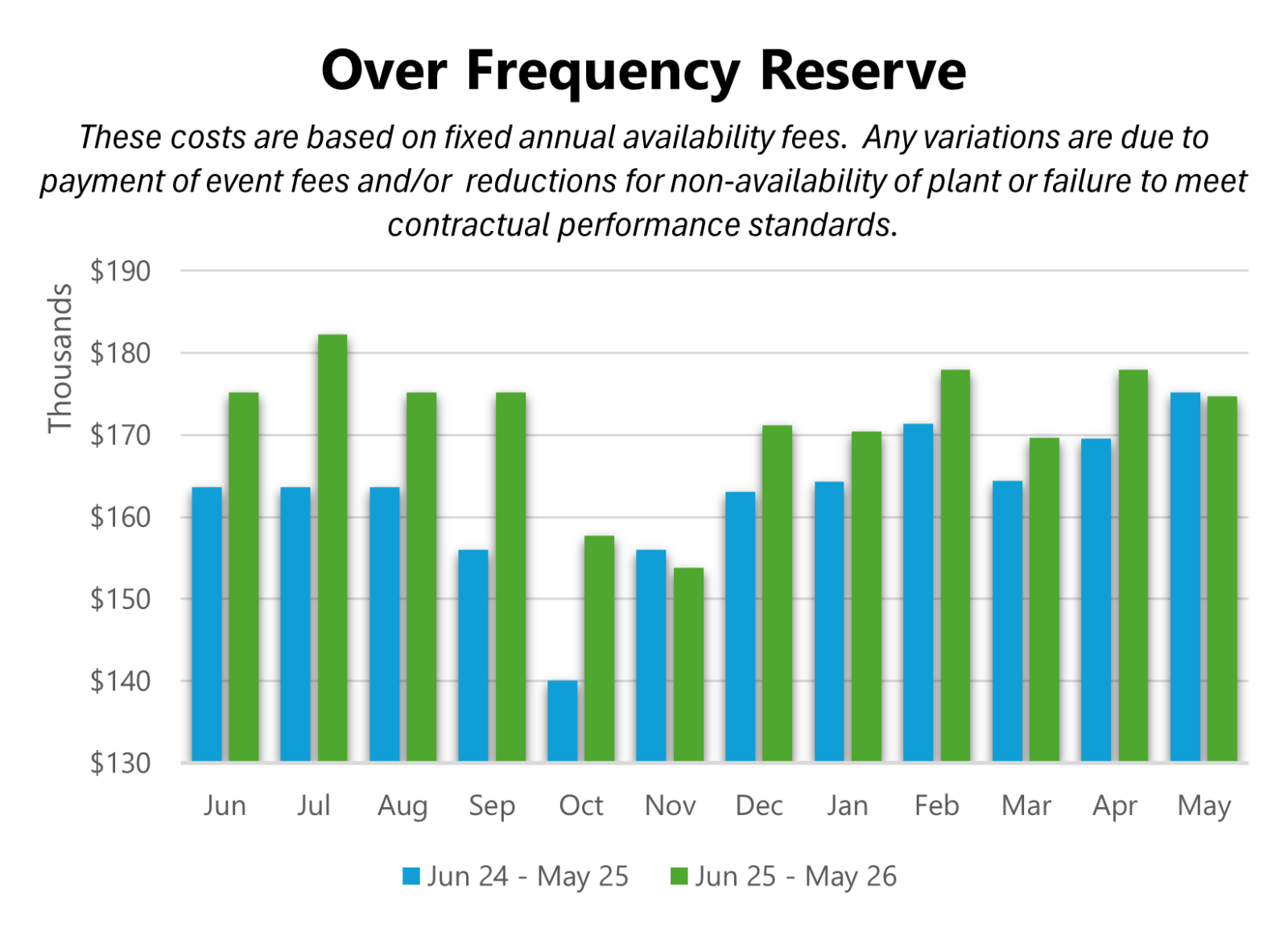
Net purchase quantity assessment
We monitor the over-frequency quantities offered by current providers and will procure additional quantities when our analysis indicates there is a need to procure more. We are also working on a broader study of OFR requirements currently.
As of February 2026, the over-frequency quantities procured are sufficient to enable the System Operator to meet its Principal Performance Obligations.