The Procurement Process

How the System Operator procures ancillary services and what providers need to do to get connected.

To meet the Principal Performance Obligations under the Electricity Industry Participation Code (the Code), the System Operator regularly assesses current and projected system needs. These assessments could result in us reviewing the Ancillary Services Procurement Plan and proposing changes to the amount and nature of each ancillary service. Such changes involve consultation(s) where the industry can provide feedback. If the Electricity Authority approves of the proposed changes, they are implemented into the Procurement Plan; future contracts are then updated to ensure alignment.

We organise each tender round to meet the forecast system security needs, and this preparatory work ensures that the tender is targeted accurately. To help potential providers understand how to participate in this process, we have outlined the key steps involved below.

The Provider Journey

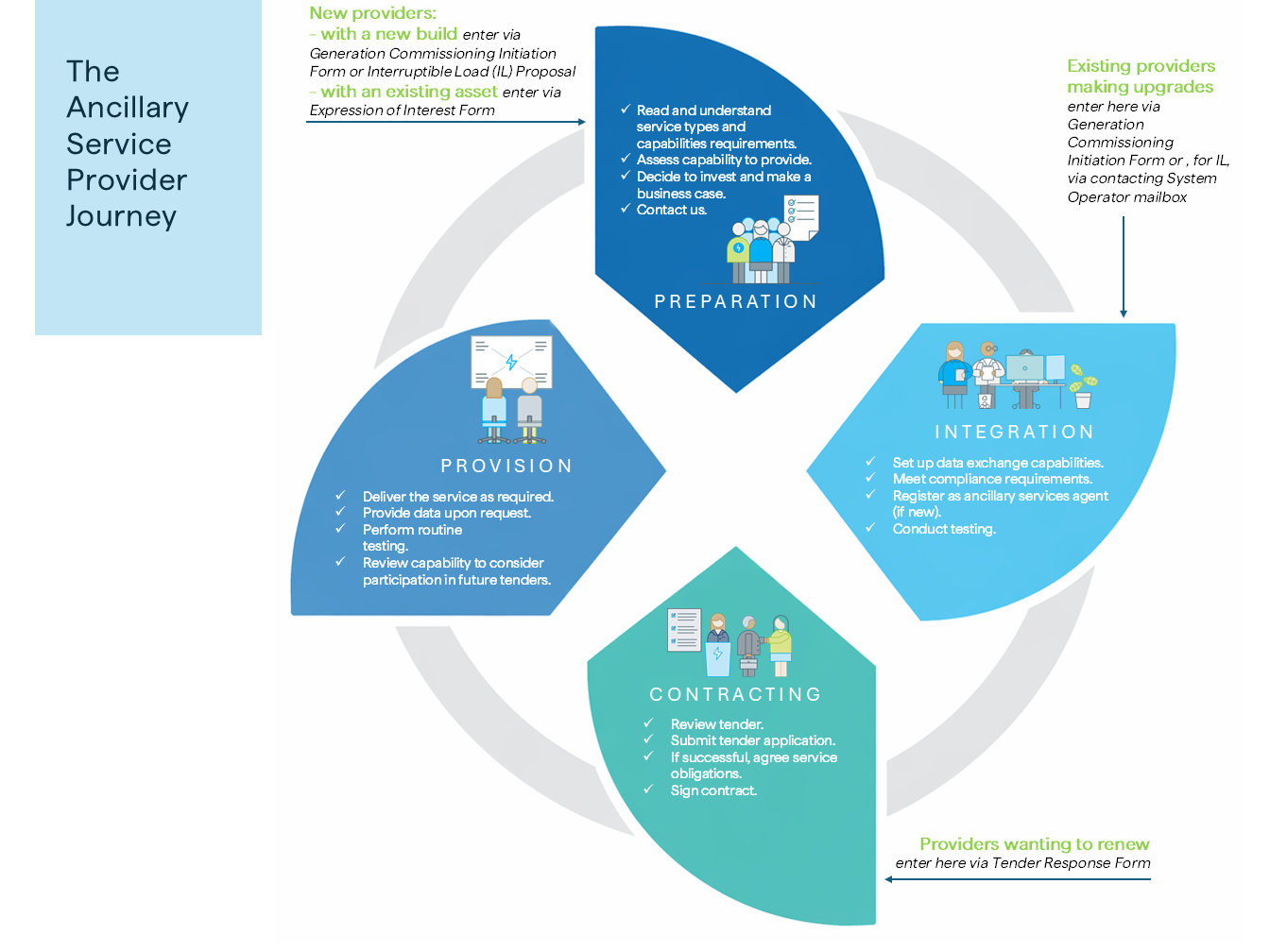
Once you have become familiar with the ancillary services we procure, you need to engage with the System Operator if you want to offer such a service to the electricity market. We have prepared the information below to call out the high-level activities involved over four phases: preparation, integration, contracting, and provision. 

Image

Select the appropriate options from the dropdown menus to view the relevant journey details, if an invalid selection is made no additional information is displayed.

You are connecting a new generating asset or battery to the power system and intend to offer black start services.

1. Preparation

To begin, read the latest information about black start on our About Ancillary Services webpage, and consult the Essential Documents webpage for further details including:

Ensure you do your research before beginning the journey to offering this service, as it is your responsibility to meet your obligations under the Electricity Industry Participation Code. 

Read through the rest of the process as it will be efficient to plan and carry out some of the activities in parallel. 

If you are about to engage the System Operator to begin the generation commissioning process, you can start that process and indicate that you intend to offer this ancillary service using the generation commissioning initiation form.

2. Integration

Once you have expressed your interest in offering black start services, you need to progress through three sets of activities that can be completed in parallel. You should already be familiar with the work involved in connecting to the power system, as it is covered in Workstreams B and C of the Generation Connection Guide. The information below summarises the additional activities involved that are specific to this ancillary service.

Ensure you begin each set of activities promptly as there are some long-lead items involved, which, if neglected, may delay your ability to provide in time for the black start tender period.

Operational Data Integration

The purpose of this workstream is to set up systems to exchange real-time data between your asset and Transpower. This process is captured on our Operational Data Integration webpage and begins with the submission of a service request via this form.

As part of this workstream, you may need to set up infrastructure to sustain the connectivity between your generating asset or battery and Transpower’s control rooms. Building this infrastructure takes significant time, so ensure you begin this early. 

You will need to use inter-control centre protocol (ICCP) for the data exchange, which will involve:

  • confirming your dataset of measurements and indications
  • modelling the connection in both your and the System Operator’s systems
  • testing the connectivity.

You must also make facilities and personnel available to always receive voice communications from the System Operator.

Market Registration

You must register with the Electricity Authority as a market participant, including for the role of ancillary service agent, and you will need apply for a unique participant identifier. You should complete this process at least 6 months prior to commissioning generation, especially if you plan to test ancillary service capability during the commissioning period. 

Also, complete NZX’s new participant onboarding to be set up as a trader in the wholesale information and trading system (WITS), which enables clearing and reconciliation support as part of NZX’s market operations services.

Capability Demonstration

To demonstrate that your generating asset or battery can provide black start services, you must test its performance. While you partake in the generation commissioning process, ensure you:

  • collaborate with the ancillary services subject matter experts during project meetings
  • indicate your intention to test this ancillary service in the Code commissioning plan
  • develop an engineering methodology that includes black start testing
  • submit operational test plans for the above testing in the specified time frame.

Most asset owners testing ancillary services carry out this testing as part of the relevant commissioning generation test sequence – and you cannot begin this until you have completed the above Operational Data Integration and Market Registration workstreams

Once you have undergone testing (and retested after failures or changes), you must submit your test results for review to the System Operator. We will review them to assess your asset’s capability.

3. Contracting

With the integration phase complete, your generating asset or battery is deemed fit to offer black start services. The next phase involves participating in the tender process as described on our Tender webpage. Submit a tender application during the appropriate tender period. If you would like to make any deviations to the contractual terms, these must be indicated in your tender application.

The System Operator will consider your application, and may provide feedback or ask questions, which you must answer promptly.

If your tender application is successful, the System Operator will offer you a contract to review and sign. You must then offer the ancillary service from the start of the contractual term.

If your tender application is unsuccessful, review any feedback provided and consider participating in the next tender round.

4. Provision

During the contractual period of your service provision, you will need to submit compliance data and participate in incident investigations at the request of the System Operator. It may also be necessary to renew or update certain contract or performance certifications.

As indicated in your contract, you will also need to routinely test your system. Liaise with the System Operator and the ancillary services subject matter experts to co-ordinate this. It will involve a similar pattern of activities to the Capability Demonstration workstream above:

  • submit operational test plans (where applicable) on time
  • undergo testing
  • submit test results for review.

You might also like to participate in System Operator consultations (for example, related to updating the Procurement Plan) or engage with Authority-led market and policy reforms.

If you wish to upgrade or modify the capability of your generating asset or battery, consult the System Operator. If the upgrade alters your asset’s performance, you may need to undertake some of the steps above again.
Your generating asset or battery is already connected to the power system and you intend to offer black start services either for the first time or after making a material upgrade to the equipment.

1. Preparation

To begin, read the latest information about black start on our About Ancillary Services webpage, and consult the Essential Documents webpage for further details including:

  • rules and regulations
  • historical and real-time data
  • performance testing
  • draft contract terms and schedules.

Whether you are intending to offer this service for the first time, or are upgrading your equipment in a way that may alter your asset’s performance, ensure you do your research. It is your responsibility to meet your obligations under the Electricity Industry Participation Code. 

Read through the rest of the process as it will be efficient to plan and carry out some of the activities in parallel. 

If you are upgrading your generating asset or battery and are about to engage the System Operator in the generation commissioning process, indicate your intent to provide this ancillary service using the generation commissioning initiation form.

If you have already commissioned your generating asset or battery and want to offer this ancillary service with that existing asset, you can let us know by filling out an Expression of Interest. If you have questions, reach out to us at [email protected].

2. Integration

With your generating asset or battery already connected to the power system, ensure you co-ordinate the activities in this phase’s three workstreams to avoid delays.

Operational Data Integration

Your generating asset or battery will already have an existing ICCP connection, and unless you are intending to make changes to the interconnection (which you can indicate using this form), there are not likely to be any material changes necessary to your ICCP dataset in order to provide this ancillary service.

If an equipment upgrade involves a change to your data exchange systems, you may need to take further steps as indicated in our Operational Data Integration process. This may also mean re-confirming your ICCP dataset and testing the connectivity.

Market Registration

As your generating asset or battery is already connected to the power system, you should already be registered as a market participant and generator with the Electricity Authority. However, if you have not offered an ancillary service before, you need to now register as an ancillary service agent.

Capability Demonstration

To demonstrate that your generating asset or battery can provide black start services, you must test its performance. 

If you are upgrading power system equipment that is important to black start service provision, such as an auxiliary or diesel generator, you must arrange to retest the ancillary service performance as part of the test sequence of your commissioning project. Your assigned lead commissioning engineer will advise you on the steps to take, but ensure that you:

  • collaborate with the ancillary services subject experts during project meetings
  • indicate your intention to test this ancillary service in the Code commissioning plan
  • develop an engineering methodology that includes black start testing
  • submit operational test plans for the above testing in the specified time frame.

Once you have undergone testing (and retested after failures or changes), you must submit your test results for review to the System Operator. We will review them to assess your asset’s capability.

3. Contracting

With the integration phase complete, your generating asset or battery is deemed fit to offer black start services. The next phase involves participating in the tender process as described on the Tender webpage. Submit a tender application during the appropriate tender period. If you would like to make any deviations to the contractual terms, these must be indicated in your tender application.

The System Operator will consider your application, and may provide feedback or ask questions, which you must answer promptly.

If your tender application is successful, the System Operator will offer you a contract to review and sign. You must then offer the ancillary service from the start of the contractual term.

If your tender application is unsuccessful, review the System Operator’s feedback and consider participating in the next tender round.

4. Provision

During the contractual period of your service provision, you will need to submit compliance data and participate in incident investigations at the request of the System Operator. It may also be necessary to renew or update certain contract or performance certifications.

As indicated in your contract, you will also need to routinely test your system. Liaise with the System Operator and the ancillary services subject experts to co-ordinate this. It will involve a similar pattern of activities to the Capability Demonstration workstream above:

  • submit operational test plans (where applicable) on time
  • undergo testing
  • submit test results for review.

You might also like to participate in System Operator consultations  (for example, related to updating the Procurement Plan) or engage with Authority-led market and policy reforms.

If you wish to upgrade or modify the capability of your generating asset or battery, consult the System Operator. If the upgrade alters your asset’s performance, you may need to undertake some of the steps above again.

You are connecting a new generating asset or battery to the power system and intend to offer over-frequency reserve services. 

1. Preparation

To begin, read the latest information about over-frequency reserves on our About Ancillary Services webpage, and consult the Essential Documents webpage for further details including:

  • rules and regulations
  • historical and real-time data
  • performance testing
  • draft contract terms and schedules.

Ensure you do your research before beginning the journey to offering this service, as it is your responsibility to meet your obligations under the Electricity Industry Participation Code.

Read through the rest of the process as it will be efficient to plan and carry out some of the activities in parallel. 

If you are about to engage the System Operator to begin the generation commissioning process, you can start that process and indicate that you intend to offer this ancillary service using the generation commissioning initiation form

2. Integration

Once you have expressed your interest in offering over-frequency reserve services, you need to progress through three sets of activities that can be completed in parallel. You should already be familiar with the work involved in connecting to the power system, as it is covered in Workstreams B and C of the Generation Connection Guide. The information below summarises the additional activities involved that are specific to this ancillary service.

Ensure you begin each set of activities promptly as there are some long-lead items involved, which, if neglected, may delay your ability to provide in time for the over-frequency reserve tender period.

Operational Data Integration

The purpose of this workstream is to set up systems to exchange real-time data between your asset and Transpower. This process is captured on our Operational Data Integration webpage and begins with the submission of a service request via this form.

As part of this workstream, you may need to set up infrastructure to sustain the connectivity between your generating asset or battery and Transpower’s control rooms. Building this infrastructure takes significant time, so ensure you begin this early.

You will need to use inter-control centre protocol (ICCP) for the data exchange, which will involve:

  • confirming your dataset 
  • modelling the connection in both your and the System Operator’s systems
  • testing the connectivity.

You must also make facilities and personnel available to always receive voice communications from the System Operator.

Market Registration

You must register with the Electricity Authority as a market participant, including for the role of ancillary service agent, and you will need apply for a unique participant identifier. You should complete this process at least 6 months prior to commissioning generation, especially if you plan to test ancillary service capability during the commissioning period. 

Also, complete NZX’s new participant onboarding to be set up as a trader in the wholesale information and trading system (WITS), which enables clearing and reconciliation support as part of NZX’s market operations services.

Capability Demonstration

To demonstrate that your generating asset or battery can provide over-frequency reserve services, you must test its performance. While you partake in the generation commissioning process, ensure you:

  • collaborate with the ancillary services subject experts during project meetings
  • indicate your intention to test this ancillary service in the Code commissioning plan
  • develop an engineering methodology that includes over-frequency arming testing
  • submit operational test plans for the above testing in the specified time frame.

Most asset owners testing ancillary services carry out this testing as part of the relevant commissioning generation test sequence – and you cannot begin this until you have completed the Operational Data Integration and Market Registration workstreams.

Once you have undergone testing (and retested after failures or changes), you must submit your test results for review to the System Operator. We will review them to assess your asset’s capability.

3. Contracting

With the integration phase complete, your generating asset or battery is deemed fit to offer over-frequency reserve services. The next phase involves participating in the tender process as described on the Tender webpage. Submit a tender application during the appropriate tender period. If you would like to make any deviations to the contractual terms, these must be indicated in your tender application.

The System Operator will consider your application, and may provide feedback or ask questions, which you must answer promptly.

If your tender application is successful, the System Operator will offer you a contract to review and sign. You must then offer the ancillary service from the start of the contractual term.

If your tender application is unsuccessful, review the System Operator’s feedback and consider participating in the next tender round.

4. Provision

During the contractual period of your service provision, you will need to submit compliance data and participate in incident investigations at the request of the System Operator. It may also be necessary to renew or update certain contract or performance certifications.

As indicated in your contract, you will also need to routinely test your system. Liaise with the System Operator and the ancillary services subject experts to co-ordinate this. It will involve a similar pattern of activities to the Capability Demonstration workstream above:

  • submit operational test plans (where applicable) on time
  • undergo testing
  • submit test results for review.

You might also like to participate in System Operator consultations (for example, related to updating the Procurement Plan) or engage with Authority-led market and policy reforms.

If you wish to upgrade or modify the capability of your generating asset or battery, consult the System Operator. If the upgrade alters your asset’s performance, you may need to undertake some of the steps above again.

Your generating asset or battery is already connected to the power system and you intend to offer over-frequency reserve services either for the first time or after making a material upgrade to the equipment.

1. Preparation

To begin, read the latest information about over-frequency reserves on our About Ancillary Services webpage, and consult the Essential Documents webpage for further details including:

  • rules and regulations
  • historical and real-time data
  • performance testing
  • draft contract terms and schedules.

Whether you are intending to provide this service for the first time, or are upgrading your equipment in a way that may alter your asset’s provision performance, ensure you do your research. It is your responsibility to meet your obligations under the Electricity Industry Participation Code.

Read through the rest of the process as it will be efficient to plan and carry out some of the activities in parallel. 

If you are upgrading your generating asset or battery and are about to engage the System Operator in the generation commissioning process, indicate your intent to provide this ancillary service using the generation commissioning initiation form.

If you have already commissioned your generating asset or battery and want to offer this ancillary service with that existing asset, you can let us know by filling out an Expression of Interest. If you have questions, reach out to us at [email protected].

2. Integration

With your generating asset or battery already connected to the power system, ensure you co-ordinate the activities in this phase’s three workstreams to avoid delays.

Operational Data Integration

Your generating asset or battery will already have an existing ICCP connection. If you want to offer over-frequency services for the first time, the System Operator requires you to include arming/disarming indication and control to your ICCP dataset (which you can indicate using this form).

If you are upgrading power system equipment, you may need to update the ICCP dataset with new indications and measurements.

Market Registration

As your generating asset or battery is already connected to the power system, you should already be registered as a market participant and generator with the Electricity Authority. However, if you have not offered an ancillary service before, you need to now register as an ancillary service agent.

Capability Demonstration

To demonstrate that your generating asset or battery can provide over-frequency reserve services, you must test its performance. 

If you are upgrading power system equipment that is important to over-frequency arming, such as the over-frequency relay, you must arrange to retest the ancillary service performance as part of the test sequence of your commissioning project. Your assigned lead commissioning engineer will advise you on the steps to take, but ensure that you:

  • collaborate with the ancillary services subject experts during project meetings
  • indicate your intention to test this ancillary service in the Code commissioning plan
  • develop an engineering methodology that includes over-frequency arming testing
  • submit operational test plans for the above testing in the specified time frame.

Once you have undergone testing (and retested after failures or changes), you must submit your test results for review to the System Operator. We will review them to assess your asset’s capability.

3. Contracting

With the integration phase complete, your generating asset or battery is deemed fit to offer over-frequency reserve services. The next phase involves participating in the tender process as described on our Tender webpage. Submit a tender application during the appropriate tender period. If you would like to make any deviations to the contractual terms, these must be indicated in your tender application.

The System Operator will consider your application, and may provide feedback or ask questions, which you must answer promptly.

If your tender application is successful, the System Operator will offer you a contract to review and sign. You must then offer the ancillary service from the start of the contractual term.

If your tender application is unsuccessful, review the System Operator’s feedback and consider participating in the next tender round.

4. Provision

During the contractual period of your service provision, you will need to submit compliance data and participate in incident investigations at the request of the System Operator. It may also be necessary to renew or update certain contract or performance certifications.

As indicated in your contract, you will also need to routinely test your system. Liaise with the System Operator and the ancillary services subject experts to co-ordinate this. It will involve a similar pattern of activities to the Capability Demonstration workstream above:

  • submit operational test plans (where applicable) on time
  • undergo testing
  • submit test results for review.

You might also like to participate in System Operator consultations (for example, related to updating the Procurement Plan) or engage with Authority-led market and policy reforms.

If you wish to upgrade or modify the capability of your generating asset or battery, consult the System Operator. If the upgrade alters your asset’s performance, you may need to undertake some of the steps above again.

You are connecting a new generating asset or battery to the power system and intend to provide single frequency keeping services.

1. Preparation

To begin, read the latest information about frequency keeping on our About Ancillary Services webpage, and consult the Essential Documents webpage for further details including:

  • rules and regulations
  • historical and real-time data
  • performance testing
  • trading and dispatch
  • draft contract terms and schedules.

Ensure you do your research before beginning the journey to offering this service, as it is your responsibility to meet your obligations under the Electricity Industry Participation Code.

Read through the rest of the process as it will be efficient to plan and carry out some of the activities in parallel. 

If you are about to engage the System Operator to begin the generation commissioning process, you can start that process and indicate that you intend to offer this ancillary service using the generation commissioning initiation form

2. Integration

Once you have expressed your interest in providing single frequency keeping services, you need to progress through three sets of activities that can be completed in parallel. You should already be familiar with the work involved in connecting to the power system, as it is covered in Workstreams B and C of the Generation Connection Guide. The information below summarises the additional activities involved that are specific to this ancillary service.

Ensure you begin each set of activities promptly as there are some long-lead items involved, which, if neglected, may delay your ability to provide in time for the frequency keeping tender period.

Operational Data Integration

The purpose of this workstream is to set up systems to exchange real-time data between your asset and Transpower. This process is captured on our Operational Data Integration webpage and begins with the submission of a service request via this form.

As part of this workstream, you must also set up network connectivity, and that may involve setting up new infrastructure to sustain the data exchange between your generating asset or battery’s and Transpower’s control rooms. Building this infrastructure takes significant time, so ensure you begin this early.

Another key decision to make early on is what dispatch system you will use: either inter-control centre protocol (ICCP) or Web Services. Whichever you choose, you must set it up and test it accordingly. Note that you need to use ICCP for exchanging real-time operational data with Transpower, so most asset owners in this situation opt for using ICCP for dispatch as well. Other important activities include:

  • confirming your dataset of measurements, indications, and dispatch tags
  • modelling the connection in both your and the System Operator’s systems
  • testing the connectivity.

You must also make facilities and personnel available to always receive voice communications from the System Operator.

Market Registration

You must register with the Electricity Authority as a market participant, including for the role of ancillary service agent, and you will need apply for a unique participant identifier. You should complete this process at least 6 months prior to commissioning generation, especially if you plan to test ancillary service capability during the commissioning period. 

In order to upload offers, you must either appoint a trading agent to manage the submission of offers (as specified in Standard Terms Part B), or have a tool capable of submitting offers such as NZX’s wholesale information and trading system (WITS) platform. You must set up WITS at least 2 months before the commissioning period. 

Ensure you also complete NZX’s new participant onboarding to be set up as a trader in WITS, which enables clearing and reconciliation support as part of NZX’s market operations services. 

Capability Demonstration

To demonstrate that your generating asset or battery can provide single frequency keeping services, you must test its performance. Monitoring equipment must also be tested to meet performance standards. While you partake in the generation commissioning process, ensure you:

  • collaborate with the ancillary services subject experts during project meetings
  • indicate your intention to test this ancillary service in the Code commissioning plan
  • develop an engineering methodology that includes frequency keeping testing
  • submit operational test plans for the above testing in the specified time frame.

Most asset owners testing ancillary services carry out this testing as part of the relevant commissioning generation test sequence – and you cannot begin this until you have completed the Operational Data Integration and Market Registration workstreams.

Once you have undergone testing (and retested after failures or changes), you must submit your test results for review to the System Operator. We will review them to assess your asset’s capability.

3. Contracting

With the integration phase complete, your generating asset or battery is deemed fit to offer frequency keeping services. The next phase involves participating in the tender process as described on our Tender webpage. Submit a tender application during the appropriate tender period. If you would like to make any deviations to the contractual terms, these must be indicated in your tender application.

The System Operator will consider your application, and may provide feedback or ask questions, which you must answer promptly.

If your tender application is successful, the System Operator will offer you a contract to review and sign. You must then offer the ancillary service from the start of the contractual term.

If your tender application is unsuccessful, review the System Operator’s feedback and consider participating in the next tender round.

4. Provision

All offers in the wholesale electricity market must be made ahead of time and cover the next 72 half-hour trading periods. You must ensure the offers are accurate and in accordance with Code obligations. The New Zealand electricity market dispatches on merit according to offer and does not provide for unconstrained dispatch.

During the contractual period of your service provision, you will need to submit compliance data and participate in incident investigations at the request of the System Operator. It may also be necessary to renew or update certain contract or performance certifications.

As indicated in your contract, you will also need to routinely test your system. Liaise with the System Operator and the ancillary services subject experts to co-ordinate this. It will involve a similar pattern of activities to the Capability Demonstration workstream above:

  • submit operational test plans (where applicable) on time
  • undergo testing
  • submit test results for review.

You might also like to participate in System Operator consultations (for example, related to updating the Procurement Plan) or engage with Authority-led market and policy reforms. 

If you wish to upgrade or modify the capability of your generating asset or battery, consult the System Operator. If the upgrade alters your asset’s performance, you may need to undertake some of the steps above again.

Your generating asset or battery is already connected to the power system and you intend to provide single frequency keeping services either for the first time or after making a material upgrade to the equipment.

1. Preparation

To begin, read the latest information about frequency keeping on our About Ancillary Services webpage, and consult the Essential Documents webpage for further details including:

  • rules and regulations
  • historical and real-time data
  • performance testing
  • trading and dispatch
  • draft contract terms and schedules.

Whether you are intending to provide this service for the first time, or are upgrading your equipment in a way that may alter your asset’s provision performance, ensure you do your research. It is your responsibility to meet your obligations under the Electricity Industry Participation Code.

Read through the rest of the process as it will be efficient to plan and carry out some of the activities in parallel. 

If you are upgrading your generating asset or battery and are about to engage the System Operator in the generation commissioning process, indicate your intent to provide this ancillary service using the generation commissioning initiation form.

If you have already commissioned your generating asset or battery and want to offer this ancillary service with that existing asset, you can let us know by filling out an Expression of Interest. If you have questions, reach out to us at [email protected].

2. Integration

With your generating asset or battery already connected to the power system, ensure you co-ordinate the activities in this phase’s three workstreams to avoid delays.

Operational Data Integration

Your generating asset or battery will already have an existing ICCP connection, and unless you are intending to make changes to the interconnection (which you can indicate using this form), there are not likely to be any significant changes to the Operational Data Integration process.

If you are upgrading power system equipment and/or offering a new dispatchable product, you may need to update the ICCP dataset with new indications and measurements. Changes to your dispatch systems or tags will also require retesting your dispatch system.

Market Registration

As your generating asset or battery is already connected to the power system, you should already be registered as a market participant and generator with the Electricity Authority and have set up your offer system to exchange information with the wholesale information trading system (WITS) platform. If you need to make any changes to your trading tool, you need to confer with NZX about this. 

If you have not offered an ancillary service before, you need to now register with the Electricity Authority as an ancillary service agent.

Capability Demonstration

To demonstrate that your generating asset or battery can provide single frequency keeping services, you must test its performance. Monitoring equipment must also be tested to meet performance standards.

If you are upgrading power system equipment that is important to frequency keeping, you must arrange to retest the ancillary service performance as part of the test sequence of your commissioning project. Your assigned lead commissioning engineer will advise you on the steps to take, but ensure that you:

  • collaborate with the ancillary services subject experts during project meetings
  • indicate your intention to test this ancillary service in the Code commissioning plan
  • develop an engineering methodology that includes frequency keeping testing
  • submit operational test plans for the above testing in the specified time frame.

Once you have undergone testing (and retested after failures or changes), you must submit your test results for review to the System Operator. We will review them to assess your asset’s capability.

3. Contracting

With the integration phase complete, your generating asset or battery is deemed fit to provide single frequency keeping services. The next phase involves participating in the tender process as described on our Tender webpage. Submit a tender application during the appropriate tender period. If you would like to make any deviations to the contractual terms, these must be indicated in your tender application.

The System Operator will consider your application, and may provide feedback or ask questions, which you must answer promptly.

If your tender application is successful, the System Operator will offer you a contract to review and sign. You must then provide the ancillary service from the start of the contractual term.

If your tender application is unsuccessful, review the System Operator’s feedback and consider participating in the next tender round.

4. Provision

All offers in the wholesale electricity market must be made ahead of time and cover the next 72 half-hour trading periods. You must ensure the offers are accurate and in accordance with Code obligations. The New Zealand electricity market dispatches on merit according to offer and does not provide for unconstrained dispatch.

During the contractual period of your service provision, you will need to submit compliance data and participate in incident investigations at the request of the System Operator. It may also be necessary to renew or update certain contract or performance certifications.

As indicated in your contract, you will also need to routinely test your system. Liaise with the System Operator and the ancillary services subject experts to co-ordinate this. It will involve a similar pattern of activities to the Capability Demonstration workstream above:

  • submit operational test plans (where applicable) on time
  • undergo testing
  • submit test results for review.

You might also like to participate in System Operator consultations (for example, related to updating the Procurement Plan) or engage with Authority-led market and policy reforms.

If you wish to upgrade or modify the capability of your generating asset or battery, consult the System Operator. If the upgrade alters your asset’s performance, you may need to undertake some of the steps above again.

You are connecting a new generating asset or battery to the power system and intend to provide multiple frequency keeping services. 

1. Preparation

To begin, read the latest information about frequency keeping on our About Ancillary Services webpage, and consult the Essential Documents webpage for further details including:

  • rules and regulations
  • historical and real-time data
  • performance testing
  • trading and dispatch
  • draft contract terms and schedules.

Ensure you do your research before beginning the journey to offering this service, as it is your responsibility to meet your obligations under the Electricity Industry Participation Code.

Read through the rest of the process as it will be efficient to plan and carry out some of the activities in parallel. 

If you are about to engage the System Operator to begin the generation commissioning process, you can start that process and indicate that you intend to offer this ancillary service using the generation commissioning initiation form.

2. Integration

Once you have expressed your interest in providing multiple frequency keeping, you need to prove your eligibility through three parallel workstreams. As you are commissioning this ancillary service as part of connecting your generation or battery to the power system, you will already be familiar with much of the work required, which is covered in Workstreams B and C of the Generation Connection Guide. Refer to the information below for a summary of the activities that are specific to the ancillary service.

Ensure you begin each stream of activity promptly as there are some long-lead items involved.

Operational Data Integration

The purpose of this workstream is to set up systems to exchange real-time data between your asset and Transpower. This process is captured on our Operational Data Integration webpage and begins with the submission of a service request via this form.

As part of this workstream, you must also set up network connectivity, and that may involve setting up new infrastructure to sustain the data exchange between your generating asset or battery’s and Transpower’s control rooms. Building this infrastructure takes significant time, so ensure you begin this early.

Another key decision to make early on is what dispatch system you will use: either inter-control centre protocol (ICCP) or Web Services. Whichever you choose, you must set it up and test it accordingly. Note that you need to use ICCP for exchanging real-time operational data with Transpower, so most asset owners in this situation opt for using ICCP for dispatch as well. 

You will also need to provide data to model your asset in the multiple frequency keeping application within both your and the System Operator’s SCADA systems and exchange frequent regulating instructions. Other important activities include:

  • confirming your dataset of measurements, indications, and dispatch tags
  • testing the connectivity.

You must also make facilities and personnel available to always receive voice communications from the System Operator.

Market Registration

You must register with the Electricity Authority as a market participant, including for the role of ancillary service agent, and you will need apply for a unique participant identifier. You should complete this process at least 6 months prior to commissioning generation, especially if you plan to test ancillary service capability during the commissioning period. 

In order to upload offers, you must either appoint a trading agent to manage the submission of offers (as specified in Standard Terms Part B), or have a tool capable of submitting offers such as NZX’s wholesale information and trading system (WITS) platform. You must set up WITS at least 2 months before the commissioning period. 

Ensure you also complete NZX’s new participant onboarding to be set up as a trader in WITS, which enables clearing and reconciliation support as part of NZX’s market operations services.

Capability Demonstration

To demonstrate that your generating asset or battery can provide multiple frequency keeping services, you must test its performance. Monitoring equipment must also be tested to meet performance standards. While you partake in the generation commissioning process, ensure you:

  • collaborate with the ancillary services subject experts during project meetings
  • indicate your intention to test this ancillary service in the Code commissioning plan
  • develop an engineering methodology that includes frequency keeping testing
  • submit operational test plans for the above testing in the specified time frame.

Most asset owners testing ancillary services carry out this testing as part of the relevant commissioning generation test sequence – and you cannot begin this until you have completed the Operational Data Integration and Market Registration workstreams.

Once you have undergone testing (and retested after failures or changes), you must submit your test results for review to the System Operator. We will review them to assess your asset’s capability.

3. Contracting

With the integration phase complete, your generating asset or battery is deemed fit to provide multiple frequency keeping services. 

For this ancillary service, you may submit a tender application during the appropriate tender period, or you may enter an out-of-cycle contract. If you would like to make any deviations to the contractual terms, indicate these when you discuss your contract with the System Operator. Once the contract is signed, you must provide the ancillary when you are dispatched, starting on the date indicated on your contract.

4. Provision

All offers in the wholesale electricity market must be made ahead of time and cover the next 72 half-hour trading periods (36 hours). You must ensure the offers are accurate and in accordance with Code obligations. The New Zealand electricity market dispatches on merit according to offer and does not provide for unconstrained dispatch.

During the contractual period of your service provision, you will need to submit compliance data and participate in incident investigations at the request of the System Operator. It may also be necessary to renew or update certain contract or performance certifications.

As indicated in your contract, you will also need to routinely test your system. Liaise with the System Operator and the ancillary services subject experts to co-ordinate this. It will involve a similar pattern of activities to the Capability Demonstration workstream above:

  • submit operational test plans (where applicable) on time
  • undergo testing
  • submit test results for review.

You might also like to participate in System Operator consultations (for example, related to updating the Procurement Plan) or engage with Authority-led market and policy reforms.

If you wish to upgrade or modify the capability of your generating asset or battery, consult the System Operator. If the upgrade alters your asset’s performance, you may need to undertake some of the steps above again.

Your generating asset or battery is already connected to the power system and you intend to provide multiple frequency keeping services either for the first time or after making a material upgrade to the equipment.

1. Preparation

To begin, read the latest information about frequency keeping on our About Ancillary Services webpage, and consult the Essential Documents webpage for further details including:

  • rules and regulations
  • historical and real-time data
  • performance testing
  • trading and dispatch
  • draft contract terms and schedules.

Whether you are intending to provide this service for the first time, or are upgrading your equipment in a way that may alter your asset’s provision performance, ensure you do your research. It is your responsibility to meet your obligations under the Electricity Industry Participation Code.

Read through the rest of the process as it will be efficient to plan and carry out some of the activities in parallel. 

If you are upgrading your generating asset or battery and are about to engage the System Operator in the generation commissioning process, indicate your intent to provide this ancillary service using the generation commissioning initiation form.

If you have already commissioned your generating asset or battery and want to offer this ancillary service with that existing asset, you can let us know by filling out an Expression of Interest. If you have questions, reach out to us at [email protected].

2. Integration

With your generating asset or battery already connected to the power system, ensure you co-ordinate the activities in this phase’s three workstreams to avoid delays.

Operational Data Integration

Your generating asset or battery will already have an existing ICCP connection. If you have never offered frequency keeping services, you will need to update your dataset to include new signals such as the MFK regulation signal. You can request an update to the dataset using this form.

If you are upgrading power system equipment, you may need to update the ICCP dataset with new indications and measurements (using the same form above). Changes to your dispatch systems or tags will also require retesting your dispatch system. 

Market Registration

As your generating asset or battery is already connected to the power system, you should already be registered as a market participant and generator with the Electricity Authority and have set up your offer system to exchange information with the wholesale information trading system (WITS) platform. If you need to make any changes to your trading tool, you need to confer with NZX about this. 

However, if you have not offered an ancillary service before, you need to now register as an ancillary service agent.

Capability Demonstration

To demonstrate that your generating asset or battery can provide multiple frequency keeping services, you must test its performance. Monitoring equipment must also be tested to meet performance standards. 

If you have already provided multiple frequency keeping services for 6 months, the System Operator may deem this sufficient demonstration of your asset’s performance. Discuss this with the ancillary services subject experts.

If you are upgrading power system equipment that is important to frequency keeping, you must arrange to retest the ancillary service performance as part of the test sequence of your commissioning project. Your assigned lead commissioning engineer will advise you on the steps to take, but ensure that you:

  • indicate your intention to test this ancillary service in the Code commissioning plan
  • develop an engineering methodology that includes frequency keeping testing
  • submit operational test plans for the above testing in the specified time frame.

Once you have undergone testing (and retested after failures or changes), you must submit your test results for review to the System Operator. We will review them to assess your asset’s capability.

3. Contracting

With the integration phase complete, your generating asset or battery is deemed fit to provide multiple frequency keeping services. The next phase involves participating in the tender process as described on our Tender webpage. 

For this ancillary service, you may submit a tender application during the appropriate tender period, or you may enter an out-of-cycle contract. If you would like to make any deviations to the contractual terms, indicate these when you discuss your contract with the System Operator. Once the contract is signed, you must provide the ancillary when you are dispatched, starting on the date indicated on your contract.

4. Provision

All offers in the wholesale electricity market must be made ahead of time and cover the next 72 half-hour trading periods (36 hours). You must ensure the offers are accurate and in accordance with Code obligations. The New Zealand electricity market dispatches on merit according to offer and does not provide for unconstrained dispatch.

During the contractual period of your service provision, you will need to submit compliance data and participate in incident investigations at the request of the System Operator. It may also be necessary to renew or update certain contract or performance certifications.

As indicated in your contract, you will also need to routinely test your system. Liaise with the System Operator and the ancillary services subject experts to co-ordinate this. It will involve a similar pattern of activities to the Capability Demonstration workstream above:

  • submit operational test plans (where applicable) on time
  • undergo testing
  • submit test results for review.

You might also like to participate in System Operator consultations (for example, related to updating the Procurement Plan) or engage with Authority-led market and policy reforms. 

If you wish to upgrade or modify the capability of your generating asset or battery, consult the System Operator. If the upgrade alters your asset’s performance, you may need to undertake some of the steps above again.

You are connecting a new generating asset or battery to the power system and intend to provide instantaneous reserve services. 

1. Preparation

To begin, read the latest information about instantaneous reserve on our About Ancillary Services webpage, and consult the Essential Documents webpage for further details including:

  • rules and regulations
  • historical and real-time data
  • performance testing
  • trading and dispatch
  • draft contract terms and schedules.

Ensure you do your research before beginning the journey to offering this service, as it is your responsibility to meet your obligations under the Electricity Industry Participation Code.

Read through the rest of the process as it will be efficient to plan and carry out some of the activities in parallel. 

If you are about to engage the System Operator to begin the generation commissioning process, you can start that process and indicate that you intend to offer this ancillary service using the generation commissioning initiation form.

2. Integration

Once you have expressed your interest in providing instantaneous reserve, you need to prove your eligibility through three parallel workstreams. As you are commissioning this ancillary service as part of connecting your generation or battery to the power system, you will already be familiar with much of the work required, which is covered in Workstreams B and C of the Generation Connection Guide. Refer to the information below for a summary of the activities that are specific to the ancillary service.

Ensure you begin each stream of activity promptly as there are some long-lead items involved.

Operational Data Integration

The purpose of this workstream is to set up systems to exchange real-time data between your asset and Transpower. This process is captured on our Operational Data Integration webpage and begins with the submission of a service request via this form.

As part of this workstream, you must also set up network connectivity, and that may involve setting up new infrastructure to sustain the data exchange between your generating asset or battery’s and Transpower’s control rooms. Building this infrastructure takes significant time, so ensure you begin this early.

Another key decision to make early on is what dispatch system you will use: either inter-control centre protocol (ICCP) or Web Services. Whichever you choose, you must set it up and test it accordingly. Note that you need to use ICCP for exchanging real-time operational data with Transpower, so most asset owners in this situation opt for using ICCP for dispatch as well. Other important activities include:

  • confirming your dataset of measurements, indications, and dispatch tags
  • modelling the connection in both your and the System Operator’s systems
  • testing the connectivity.

You must also make facilities and personnel available to always receive voice communications from the System Operator.

Market Registration

You must register with the Electricity Authority as a market participant, including for the role of ancillary service agent, and you will need apply for a unique participant identifier. You should complete this process at least 6 months prior to commissioning generation, especially if you plan to test ancillary service capability during the commissioning period. 

In order to upload offers, you must either appoint a trading agent to manage the submission of offers (as specified in Standard Terms Part B), or have a tool capable of submitting offers such as NZX’s wholesale information and trading system (WITS) platform. You must set up WITS at least 2 months before the commissioning period. 

Ensure you also complete NZX’s new participant onboarding to be set up as a trader in WITS, which enables clearing and reconciliation support as part of NZX’s market operations services.

Capability Demonstration

To demonstrate that your generating asset or battery can provide instantaneous reserve services, you must test its performance. Monitoring equipment must also be tested to meet performance standards. While you partake in the generation commissioning process, ensure you:

  • collaborate with the ancillary services subject experts during project meetings
  • indicate your intention to test this ancillary service in the Code commissioning plan
  • develop an engineering methodology that includes instantaneous reserve testing
  • submit operational test plans for the above testing in the specified time frame.

Most asset owners testing ancillary services carry out this testing as part of the relevant commissioning generation test sequence – and you cannot begin this until you have completed the Operational Data Integration and Market Registration workstreams.

Once you have undergone testing (and retested after failures or changes), you must submit your test results and a validated power system model. We will review them to assess your asset’s capability and adjust the System Operator’s Reserve Management Tool (RMT) to model your asset. Note that changes to RMT need to be audited, which can take up to three months.

3. Contracting

With the integration phase complete, your generating asset or battery is deemed fit to provide instantaneous reserve services. 

For this ancillary service, you may submit a tender application during the appropriate tender period, or you may enter an out-of-cycle contract. If you would like to make any deviations to the contractual terms, indicate these when you discuss your contract with the System Operator. Once the contract is signed, you must provide the ancillary when you are dispatched, starting on the date indicated on your contract.

4. Provision

All offers in the wholesale electricity market must be made ahead of time and cover the next 72 half-hour trading periods (36 hours). You must ensure the offers are accurate and in accordance with Code obligations. The New Zealand electricity market dispatches on merit according to offer and does not provide for unconstrained dispatch.

During the contractual period of your service provision, you will need to submit compliance data at the request of the System Operator. You can be notified of events by subscribing to Customer Advice Notices. It may also be necessary to renew or update certain contract or performance certifications.

As indicated in your contract, you will also need to routinely test your system. Liaise with the System Operator and the ancillary services subject experts to co-ordinate this. It will involve a similar pattern of activities to the Capability Demonstration workstream above:

  • submit operational test plans (where applicable) on time
  • undergo testing
  • submit test results for review
  • submit an updated validated power system model if capability differs significantly from earlier modelling.

You might also like to participate in System Operator consultations (for example, related to updating the Procurement Plan) or engage with Authority-led market and policy reforms. 

If you wish to upgrade or modify the capability of your generating asset or battery, consult the System Operator. If the upgrade alters your asset’s performance, you may need to undertake some of the steps above again.

Your generating asset or battery is already connected to the power system and you intend to provide instantaneous reserve services either for the first time or after making a material upgrade to the equipment.

1. Preparation

To begin, read the latest information about instantaneous reserve on our About Ancillary Services webpage, and consult the Essential Documents webpage for further details including:

  • rules and regulations
  • historical and real-time data
  • performance testing
  • trading and dispatch
  • draft contract terms and schedules.

Whether you are intending to provide this service for the first time, or are upgrading your equipment in a way that may alter your asset’s provision performance, ensure you do your research. It is your responsibility to meet your obligations under the Electricity Industry Participation Code.

Read through the rest of the process as it will be efficient to plan and carry out some of the activities in parallel. 

If you are upgrading your generating asset or battery and are about to engage the System Operator in the generation commissioning process, indicate your intent to provide this ancillary service using the generation commissioning initiation form.

If you have already commissioned your generating asset or battery and want to offer this ancillary service with that existing asset, you can let us know by filling out an Expression of Interest. If you have questions, reach out to us at [email protected].

2. Integration

With your generating asset or battery already connected to the power system, ensure you co-ordinate the activities in this phase’s three workstreams to avoid delays.

Operational Data Integration

Your generating asset or battery will already have an existing ICCP connection, and unless you are intending to make changes to the interconnection (which you can indicate using this form), there are not likely to be any significant changes to the Operational Data Integration process.

If you are upgrading power system equipment, you may need to update the ICCP dataset with new indications and measurements. Changes to your dispatch systems or tags will also require retesting your dispatch system. 

Market Registration

As your generating asset or battery is already connected to the power system, you should already be registered as a market participant and generator with the Electricity Authority and have set up your offer system to exchange information with the wholesale information trading system (WITS) platform. If you need to make any changes to your trading tool, you need to confer with NZX about this. 

However, if you have not offered an ancillary service before, you need to now register as an ancillary service agent.

Capability Demonstration

To demonstrate that your generating asset or battery can provide instantaneous reserve services, you must test its performance. Monitoring equipment must also be tested to meet performance standards. 

If you are upgrading power system equipment that is important to instantaneous reserve service provision, you must arrange to retest the ancillary service performance as part of the test sequence of your commissioning project. Your assigned lead commissioning engineer will advise you on the steps to take, but ensure that you:

  • indicate your intention to test this ancillary service in the Code commissioning plan
  • develop an engineering methodology that includes instantaneous reserve testing
  • submit operational test plans for the above testing in the specified time frame.

Once you have undergone testing (and retested after failures or changes), you must submit your test results and an updated validated power system model (if your upgraded equipment has meant there are significant differences from the previously provided model). We will review them to assess your asset’s capability and adjust the System Operator’s Reserve Management Tool (RMT) to model your asset. Note that changes to RMT need to be audited, which can take up to three months.

3. Contracting

With the integration phase complete, your generating asset or battery is deemed fit to provide instantaneous reserve services. 

For this ancillary service, you may submit a tender application during the appropriate tender period, or you may enter an out-of-cycle contract. If you would like to make any deviations to the contractual terms, indicate these when you discuss your contract with the System Operator. Once the contract is signed, you must provide the ancillary when you are dispatched, starting on the date indicated on your contract.

4. Provision

All offers in the wholesale electricity market must be made ahead of time and cover the next 72 half-hour trading periods (36 hours). You must ensure the offers are accurate and in accordance with Code obligations. The New Zealand electricity market dispatches on merit according to offer and does not provide for unconstrained dispatch.

During the contractual period of your service provision, you will need to submit compliance data at the request of the System Operator. You can be notified of events by subscribing to Customer Advice Notices. It may also be necessary to renew or update certain contract or performance certifications. 

As indicated in your contract, you will also need to routinely test your system. Liaise with the System Operator and the ancillary services subject experts to co-ordinate this. It will involve a similar pattern of activities to the Capability Demonstration workstream above:

  • submit operational test plans (where applicable) on time
  • undergo testing
  • submit test results for review
  • submit an updated validated power system model if capability differs significantly from earlier modelling.

You might also like to participate in System Operator consultations (for example, related to updating the Procurement Plan) or engage with Authority-led market and policy reforms. 

If you wish to upgrade or modify the capability of your generating asset or battery, consult the System Operator. If the upgrade alters your asset’s performance, you may need to undertake some of the steps above again.


You are connecting to the power system and intend to provide instantaneous reserve services as interruptible load. 

1. Preparation

To begin, read the latest information about instantaneous reserve on our About Ancillary Services webpage, and consult the Essential Documents webpage for further details including:

  • rules and regulations
  • historical and real-time data
  • performance testing
  • trading, dispatch and demand participation
  • draft contract terms and schedules.

Ensure you do your research before beginning the journey to offering this service, as it is your responsibility to meet your obligations under the Electricity Industry Participation Code.

Read through the rest of the process as it will be efficient to plan and carry out some of the activities in parallel. 

Begin your engagement with the System Operator by filling out the Interruptible Load Application template and submitting it to [email protected].

2. Integration

Once you have expressed your interest in providing instantaneous reserve as interruptible load, you need to prove your eligibility through three parallel workstreams. Ensure you begin each stream of activity promptly as there are some long-lead items involved.

Operational Data Integration

The purpose of this workstream is to set up systems to exchange real-time dispatch data with Transpower. This process is captured on our Operational Data Integration webpage and begins with the submission of a service request via this form.

A key decision to make early on is what dispatch system you will use: either inter-control centre protocol (ICCP) or Web Services. Whichever you choose, you must set it up and test it accordingly. Note that setting up infrastructure that supports ICCP connectivity takes a significant amount of time and investment, so most load providers in this situation opt for using Web Services for dispatch as it is a lower cost option. Other important activities include:

  • confirming your dispatch tags (for ICCP)
  • connectivity setup (e.g. whitelisting)
  • testing the dispatch system connectivity.

You must also make facilities and personnel available to always receive voice communications from the System Operator.

Market Registration

You must register as a market participant and ancillary services agent with the Electricity Authority and apply for a unique participant identifier at least six months prior to connecting to the power system. 

In order to upload bids, you must either appoint a trading agent to manage your bid submissions (as specified in Standard Terms Part B), or have a tool capable of submitting bids such as the wholesale information and trading system (WITS) platform from NZX. You must set up WITS at least 2 months before connecting to the power system.

Ensure you also complete NZX’s new participant onboarding to be set up as a trader in WITS, which enables clearing and reconciliation support as part of NZX’s market operations services.

Capability Demonstration

To demonstrate that you can provide instantaneous reserve services as interruptible load, you must undergo performance testing. Monitoring equipment must also be tested to meet performance standards. After submitting your interruptible load application (see Preparation phase), the ancillary services subject experts will provide feedback. Collaborate with them during project meetings to:

  • refine your test methodology (initially captured in your application)
  • submit operational test plans for the above testing in the specified time frame.

You cannot begin to test your system’s ability to provide instantaneous reserve as interruptible load until you have completed the Operational Data Integration and Market Registration workstreams.

Once you have undergone testing (and retested after failures or changes), you must submit your test results for System Operator review. 

3. Contracting

With the integration phase complete, your system is deemed fit to provide instantaneous reserve services as interruptible load. 

For this ancillary service, you may submit a tender application during the appropriate tender period, or you may enter an out-of-cycle contract. If you would like to make any deviations to the contractual terms, indicate these when you discuss your contract with the System Operator. Once the contract is signed, you must provide the ancillary when you are dispatched, starting on the date indicated on your contract.

4. Provision

All offers in the wholesale electricity market must be made ahead of time and cover the next 72 half-hour trading periods (36 hours). You must ensure the offers are accurate and in accordance with Code obligations. The New Zealand electricity market dispatches on merit according to offer and does not provide for unconstrained dispatch.

During the contractual period of your service provision, you will need to submit compliance data at the request of the System Operator. You can be notified of events by subscribing to Customer Advice Notices. It may also be necessary to renew or update certain contract or performance certifications.

If your load portfolio changes, let the System Operator know and your contract can be adjusted to reflect the new MW total for FIR and SIR. In this case, you will need to provide information and test data to verify the new capacity).

As indicated in your contract, you will also need to routinely test your system. Liaise with the System Operator and the ancillary services subject experts to co-ordinate this. It will involve a similar pattern of activities to the Capability Demonstration workstream above:

  • submit operational test plans (where applicable) on time
  • undergo testing
  • submit test results for review.

You might also like to participate in System Operator consultations (for example, related to updating the Procurement Plan) or engage with Authority-led market and policy reforms. 

If you wish to upgrade or modify the capability of your system, consult the System Operator. If the upgrade alters its performance, you may need to undertake some of the steps above again.

You are already connected to the power system and provide instantaneous reserve as interruptible load, and you wish to add a new interruptible load type.

1. Preparation

To begin, read the latest information about instantaneous reserve on our About Ancillary Services webpage, and consult the Essential Documents webpage for further details including:

  • rules and regulations
  • historical and real-time data
  • performance testing
  • trading, dispatch and demand participation
  • draft contract terms and schedules.

As with any proposed changes to your system, remember it is your responsibility to meet your obligations under the Electricity Industry Participation Code.

Read through the rest of the process as it will be efficient to plan and carry out some of the activities in parallel. 

To begin your engagement with the System Operator, contact [email protected] and inform us of your upgrade plans.

2. Integration

The activities in this phase occur in the following three workstreams. Ensure you co-ordinate activities in parallel, where possible, to avoid delays.

Operational Data Integration

Your system will already have an existing dispatch system (ICCP or Web Services), so any changes to that or your dispatch tags will require retesting. 

Market Registration

As your system is already connected to the power system, you should already be registered as a market participant and ancillary services agent with the Electricity Authority and have set up your offer system to exchange information with the wholesale information trading system (WITS) platform. If you need to make any changes to your trading tool, you need to confer with NZX about this. 

Capability Demonstration

To demonstrate that your system can provide instantaneous reserve services with the addition of a new interruptible load type, you must test its performance. Monitoring equipment must also be tested to meet performance standards. Discuss what steps you need to take with your ancillary services subject experts, as you might only need to submit operational test plans for this testing in the specified time frame. Once you have undergone testing (and retested after failures or changes), you must submit your test results for System Operator review. 

3. Contracting

With the integration phase complete, your system is deemed fit to provide instantaneous reserve services as interruptible load. 

For this ancillary service, you may submit a tender application during the appropriate tender period, or you may enter an out-of-cycle contract. If you would like to make any deviations to the contractual terms, indicate these when you discuss your contract with the System Operator. Once the contract is signed, you must provide the ancillary when you are dispatched, starting on the date indicated on your contract.

4. Provision

All offers in the wholesale electricity market must be made ahead of time and cover the next 72 half-hour trading periods (36 hours). You must ensure the offers are accurate and in accordance with Code obligations. The New Zealand electricity market dispatches on merit according to offer and does not provide for unconstrained dispatch.

During the contractual period of your service provision, you will need to submit compliance data at the request of the System Operator. You can be notified of events by subscribing to Customer Advice Notices. It may also be necessary to renew or update certain contract or performance certifications.

If your load portfolio changes, let the System Operator know and your contract can be adjusted to reflect the new MW total for FIR and SIR. In this case, you will need to provide information and test data to verify the new capacity).

As indicated in your contract, you will also need to routinely test your system. Liaise with the System Operator and the ancillary services subject experts to co-ordinate this. It will involve a similar pattern of activities to the Capability Demonstration workstream above:

  • submit operational test plans (where applicable) on time
  • undergo testing
  • submit test results for review.

You might also like to participate in System Operator consultations (for example, related to updating the Procurement Plan) or engage with Authority-led market and policy reforms. 

If you wish to make further modifications to your system, consult the System Operator. If the upgrade alters its performance, you may need to undertake some of the steps above again.


Select the Ancillary Service, Provider Type and whether it's new or existing to get breakdown of requirements.