Testing Requirements
Whether you are performing routine or special case checks, or are progressing through the commissioning generation process, testing helps you to demonstrate that you can meet your Code obligations by clarifying your asset’s capabilities. Refer to Chapter 7 of the Connected Asset Commissioning, Testing, and Information Standard (CACTIS) for the mandated requirements that apply to various assets, including:
- Synchronous generating units
- Inverter-based resources (wind, solar, batteries)
- Shunt capacitors and reactive power control systems
- Dynamic reactive power compensation devices
- Alternating current (AC) protection systems
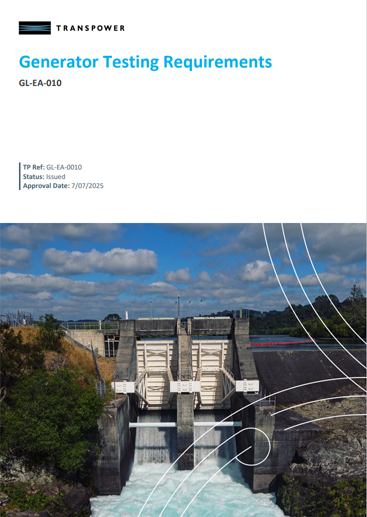
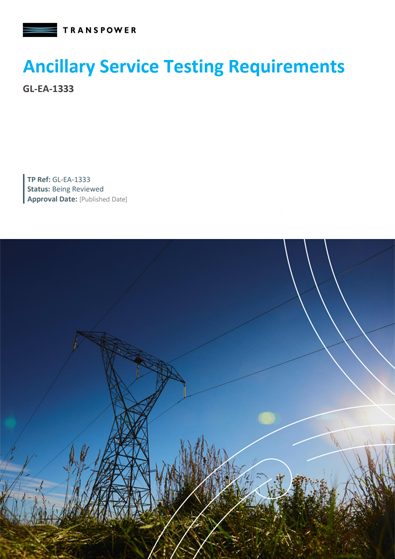
The System Operator has prepared the following guideline documents to assist your testing. Click on the cover to access the relevant document:
For Generating Assets (GL-EA-010) | For Ancillary Services (GL-EA-1333) |
|
Image
|
Image
|
| Details requirements for demonstrating the performance of generating assets through commissioning and routine testing. | Details requirements for testing of generating and load assets for the purpose of ancillary service provision. |
Additionally, the following testing guidelines are available:
| Document | What it’s for |
|---|---|
| GL-EA-765 Grid Asset Test Requirements | Details testing requirements for grid assets other than generators, including STATCOM and SVC. |
| GL-EA-766 Distribution Asset Test Requirements | Outlines testing requirements for distribution assets. |
If you have any questions about any of the requirements that may apply to you, reach out to [email protected].
Submitting Test Plans
The Code requires Asset Owners to advise the System Operator of proposed testing that would result in certain changes at the grid interface. You must also inform us if your testing aims to demonstrate asset capability or may affect our ability to meet our Principal Performance Obligations (PPOs) or achieve the dispatch objective, or if it may affect the accuracy of operational communications. Such situations may include:
- Distributors conducting drop load testing*
- Generators conducting reactive capability testing
- Load rejection testing*
- Indication and measurement testing
* with drop load or load rejection testing above 30 MW (single / instantaneous step up or down), please call Transpower’s National Coordination Centre, Security Coordinator 15 minutes before such planned test on 0800 488 500, in case there are coinciding tests or a live event unfolding on the power system. Gaining “permission to proceed” for high-impact testing will likely minimise unforeseen security implications and reduce the likelihood of an asset owner being identified as the causer of an under-frequency event.
You must complete and submit operational test plans for all such situations. Use the correct test plan form for your particular testing and email it to [email protected].
| Form | To use when... |
|---|---|
| FM-EA-010 Test Plan | Performing operational tests - for all occasions except the ones below. |
| FM-EA-502 SFK Test Plan | Testing for provision of backup single frequency keeping ancillary service. |
It is important to send test plans to the System Operator at least 15 business days before planned testing, as your testing may have effects that we must mitigate with our own operational planning. If you cannot provide the required advance notice, you must contact the Duty Operations Manager at 07 843 0618. Consult them also if you are unsure whether your testing will have a wider impact on the power system.
To find out more about how asset test plans are managed within the System Operator, refer to our PR-EA-010 Planned and Urgent Asset Testing document.
After Testing: Reminders
Following your operational testing, please:
- update your Asset Capability Statement
- submit your test results
- complete the appropriate step below:
- if this is a new connection, submit a validated model of your asset to the System Operator;
- if this is an existing connection with performance changes demonstrated by the testing, you should also submit a validated model;
- if this is an existing connection with no performance changes, you should share the test results and confirm no changes to your plant’s mathematical model are required.
- if you conducted over-frequency arming tests (from GL-EA-1333), submit an FM-EA-997 OFR Test Form.
Learn more about our modelling requirements by visiting our Power System Studies and Modelling page. For more detailed information about what is required after testing, refer to the testing guideline documents above.