Connection Studies
Asset owners need to perform connection studies to simulate the performance of their generating asset when connecting to the wider power system. Refer to Chapter 5 of the Connected Asset Commissioning, Testing and Information Standard (CACTIS) for the mandated connection studies. These must be completed during the delivery phase of the commissioning process, as Chapter 1 of CACTIS indicates. If you are undergoing the commissioning generation process, we expect you to scope and plan these early on in your engagement with us.
The System Operator will review these studies to:
- assess the new generating station’s ability to help the system operator plan and meet the Principal Performance Obligations
- anticipate any potential operational issues that can constrain the operation of the new generating station, such as thermal constraints, transient or voltage stability issues
- assess compliance to the Code, including requirements such as reactive power, frequency control, and fault ride through standards, to ensure the new generating station does not reduce the supply quality and reliability
- minimise risk during commissioning and testing
- assess the impact of the new generation connection on power system stability and supply security
- ensure power system operation and other grid connection parties are not affected by the new generation connection
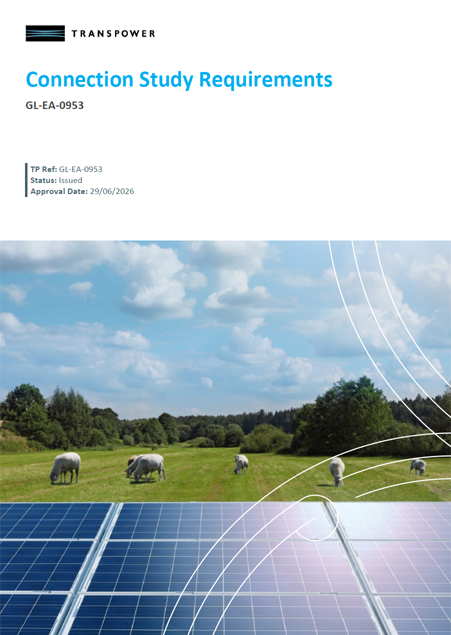
As indicated in our GL-EA-953 Connection Study Requirements guideline (pictured to the left), these studies will need to be conducted using a vendor RMS model on the PowerFactory case file and/or a vendor EMT model on one of the EMT cases provided in the Fault Ride Through section below.
Further details on the following studies can be found in the guideline:
- Power-flow
- Reactive power capability
- Frequency regulation and tuning
- Voltage regulation and tuning
- Short circuit
- Fault ride through (see further notes below)
- Transient stability
Once you have completed your connection studies, you will need to submit a report along with study casefiles and an unvalidated vendor model of your asset to your assigned commissioning engineer and to [email protected].
- Information for Fault Ride Through (FRT) Studies
FRT studies are a Code requirement and must be demonstrated using power system analysis i.e. RMS studies and/or EMT studies.
To perform an EMT study, use your vendor EMT model and the EMT network models provided below. To complete your FRT study, use the relevant case study and system assumptions. We provide asset owners with system assumptions on a case-by-case basis, so please contact us on [email protected] with your request. To support you with your EMT study, we recommend you refer to the user manual and relevant PSCAD EMT model files below.
These EMT network models are for Fault Ride Through studies associated with connection studies. The System Operator does not provide support for using the EMT network models in other types of studies. For questions or improvement suggestions, contact [email protected].
The North Island and South Island EMT network models require PRSIM to import power flow data from PowerFactory and reduce the network outside of the study area. These newer models are the preferred models for use in EMT studies.
Model for use in Model Model Version User Guide North Island 1.0 South Island (not yet available) The older Grid Zone EMT network models and user guides remain available below. These Grid Zone models do not require PRSIM. As of September 2026, they are no longer being updated and will be phased out in the future.
To complete your FRT study, use the relevant case study and system assumptions. We provide asset owners with system assumptions on a case-by-case basis, so please contact us on [email protected] with your request.
- FRT Assumptions Documents
When conducting FRT studies, use the appropriate assumptions document below:
Grid Zone Document 1. Northland FRT Assumptions GZ 01.pdf 2. Auckland FRT Assumptions GZ 02.pdf 3. Hamilton FRT Assumptions GZ 03.pdf 4. Edgecumbe FRT Assumptions GZ 04.pdf 5. Hawkes Bay FRT Assumptions GZ 05.pdf 6. Taranaki FRT Assumptions GZ 06.pdf 7. Bunnythorpe FRT Assumptions GZ 07.pdf 8. Wellington FRT Assumptions GZ 08.pdf 9. Nelson (coming soon - please contact the System Operator) 10. Christchurch FRT Assumptions GZ 10.pdf 11. Canterbury FRT Assumptions GZ 11.pdf 12. West Coast FRT Assumptions GZ 12.pdf 13. Otago (coming soon - please contact the System Operator) 14. Southland FRT Assumptions GZ 14.pdf
Modelling Requirements
Power system models are crucial for the accurate simulations of the network. Depending on the type of generating asset you have and its output size, different modelling requirements apply. These are explained in Chapter 4 of the Connected Asset Commissioning, Testing, and Information Standard (CACTIS) and are required at two key points during the commissioning process:
- During the delivery phase, as part of completing connection studies (in the CACTIS, this is referred to as an M1 model).
- During the closeout phase, as part of validating your models against commissioning test results (in the CACTIS, this is referred to as an M2 model).
What model(s) do I need to provide?
Select your asset specifications from the dropdown menus below to reveal your generating asset’s baseline modelling requirements. Note: the obligations appear only when all three selections are made. If you have any questions about the modelling requirements that apply to your asset, email us at [email protected].
To understand the software specifications, quality, testing and validation process requirements for each model, refer to the relevant guideline below (the images are hyperlinked).
| For Synchronous Assets (GL-EA-716) | For Inverter-based Resources (GL-EA-1311) |
|
Image
|
Image
|
| Applies to synchronous generating units and synchronous condensers | Applies to wind and solar generating units, batteries (BESS), dynamic reactive power compensation devices, and doubly-fed induction generators (DFIG) |
We also provide the following to PowerFactory example to help with fulfilling the requirements:
- Confidentiality
To meet its statutory responsibilities for operating the power system and maintaining system security and reliability, the System Operator requires access to accurate and complete generation asset model information. For assets with voltage and/or frequency support obligations, we expect asset owners to provide encrypted and unencrypted models, along with associated data necessary for power system studies, event analysis, and operational planning. See the definitions and chapter 4 of the Connected Asset Commissioning, Testing and Information Standard (CACTIS) for clarity on what we require.
The provision of specified model information is a condition of connection. Where an asset owner does not provide the model information required, the System Operator cannot progress the connection of their asset to the power system.
The System Operator receives and uses this model information in line with the provisions of our regulatory framework, including as set out in clause 3(2) and 3(2A) of the Electricity Industry Participation Code 2010 Schedule 8.3, Technical Code A which contains strict restrictions on disclosure. We manage asset information within this framework and apply rigorous controls to ensure it is handled consistently with our statutory obligations and the needs of the power system.
Under this regulatory framework, many original equipment manufacturers with assets operating in New Zealand are sharing unencrypted and partially encrypted models with us. We understand these to be commercially sensitive and highly confidential, so it is imperative that we protect that information. In accordance with Schedule 8.3 Technical Code A 3 (2A), the System Operator stores the information on a secure server with strictly limited accessibility. More information about our model management processes is captured in our Model Confidentiality Management Policy.
If an original equipment manufacturer requires further information regarding our model use, contact [email protected].